Sintra is a magical place. Not often do I remember my trips with such sheer vividness and fondness alike. Anyone who visits Lisbon, simply must also find the time (and you need a full day) to visit.
Seriously, I will personally come over to your house and slap you with a fatty, oil slathered rasher of tripeiros if you visit Lisbon without considering Sintra.
Sintra was a short and easy train ride away from Lisbon. The morning was grey, cold and breezy and I hadn’t brought any form of jacket or coat. I stepped off the train with some trepidation, an unnerving start. I needn’t have worried.
Once we had worked out the mildly confusing bus routes, we established there were three points of interest to hit – The Moorish Castle, Pena Palace and what I was personally looking forward to seeing the most, Quinta Da Regaleira.
The Moorish Castle (Castelo Dos Mouros)
The impressive spread of the Moorish Castle dates from the 9th century. Constructed originally to guard the population of Sintra, things went a bit wrong during the Siege of Lisbon where Christian forces overpowered the Muslims and it fell into disrepair over a course of a few centuries. It got rebuilt in the 13th and 14th Century, although by that time most people were figuring out that it was a bit of faff to live atop of a hilltop inside a fortified city and the population diminished to live down by the village itself. Following that, there was a fire, and then a gigantic earthquake – life is tough for castles. King Ferdinand eventually remodelled the place into a romantic, ancient ruin in the 19th Century though, as for all its problems, it was a pretty view from Pena Palace.
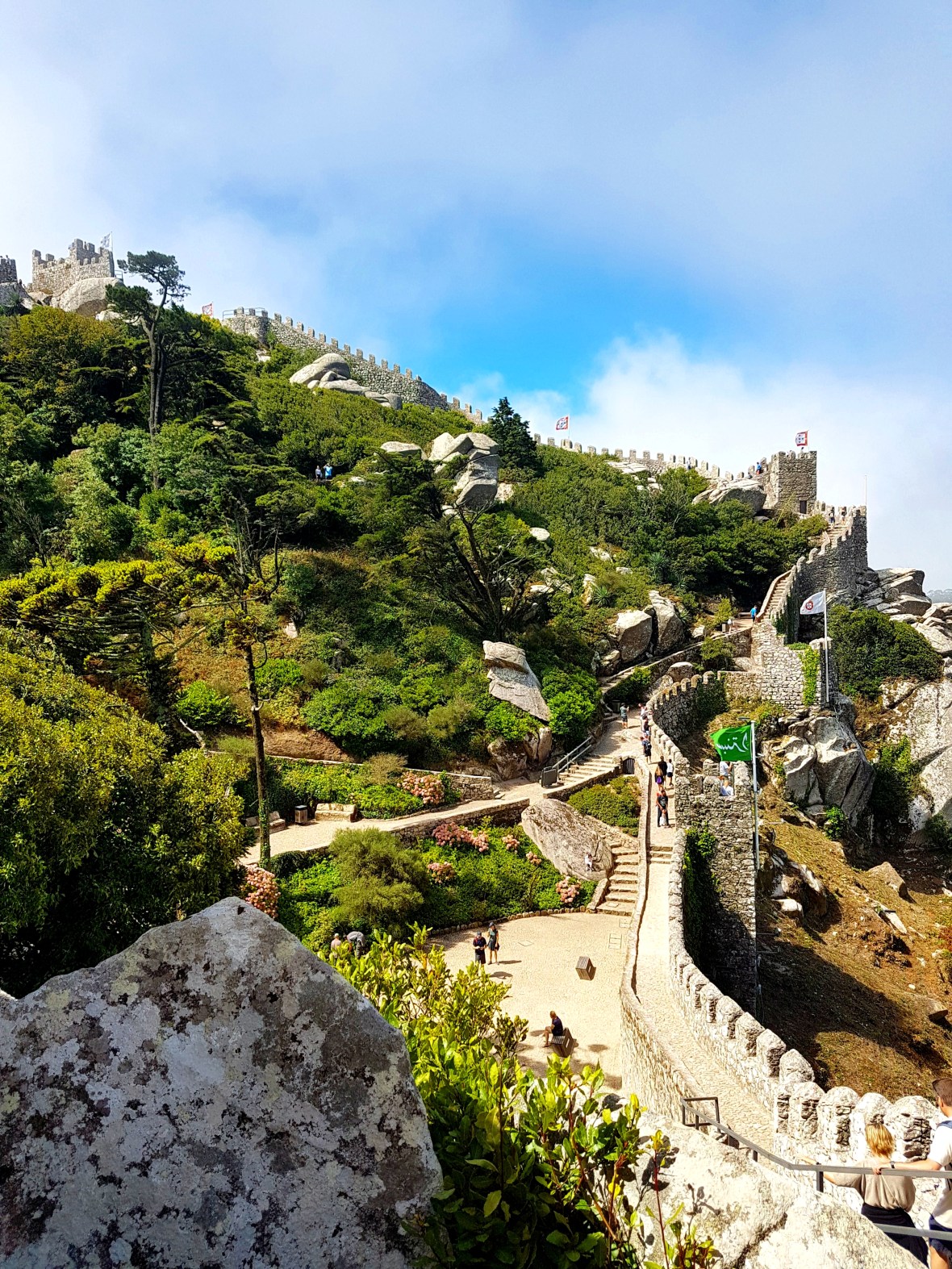
Clear blue skies opened up as we explored the castle walls
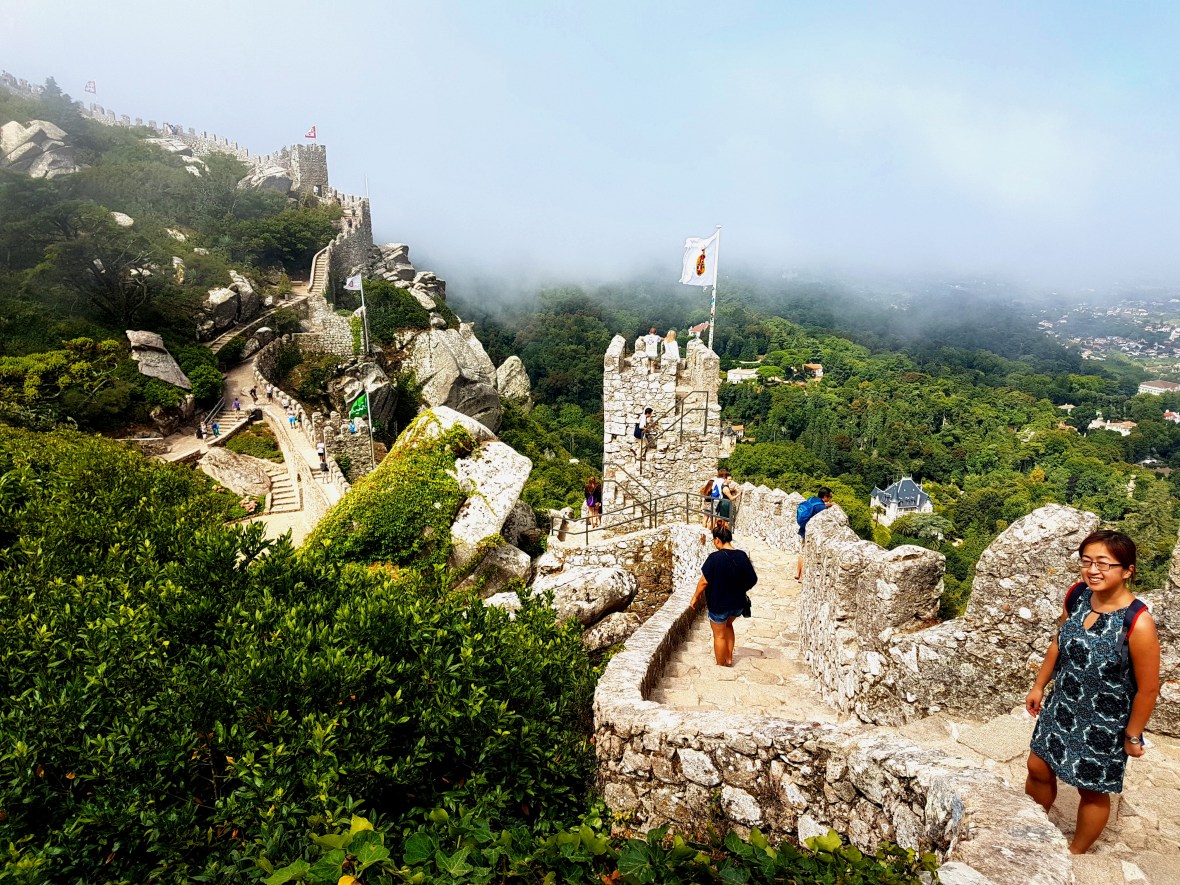
At such a height, dense mist often wafted around the fortress, obscuring the views but adding a romance and mystique to the thousand something year old setting.
Whilst it’s likely to cause huge offense to the Portuguese (and to the Chinese too, now that I think about it), it reminded me a lot of the Great Wall of China. Such is my extensive knowledge of big, long walls. However, whilst the Great Wall was more “epic” in it’s history, fame and sheer length – there was lush vegetation, a Game of Thronesy feel going on and a fairy tale view of Pena Palace. King Ferdinand was onto something.
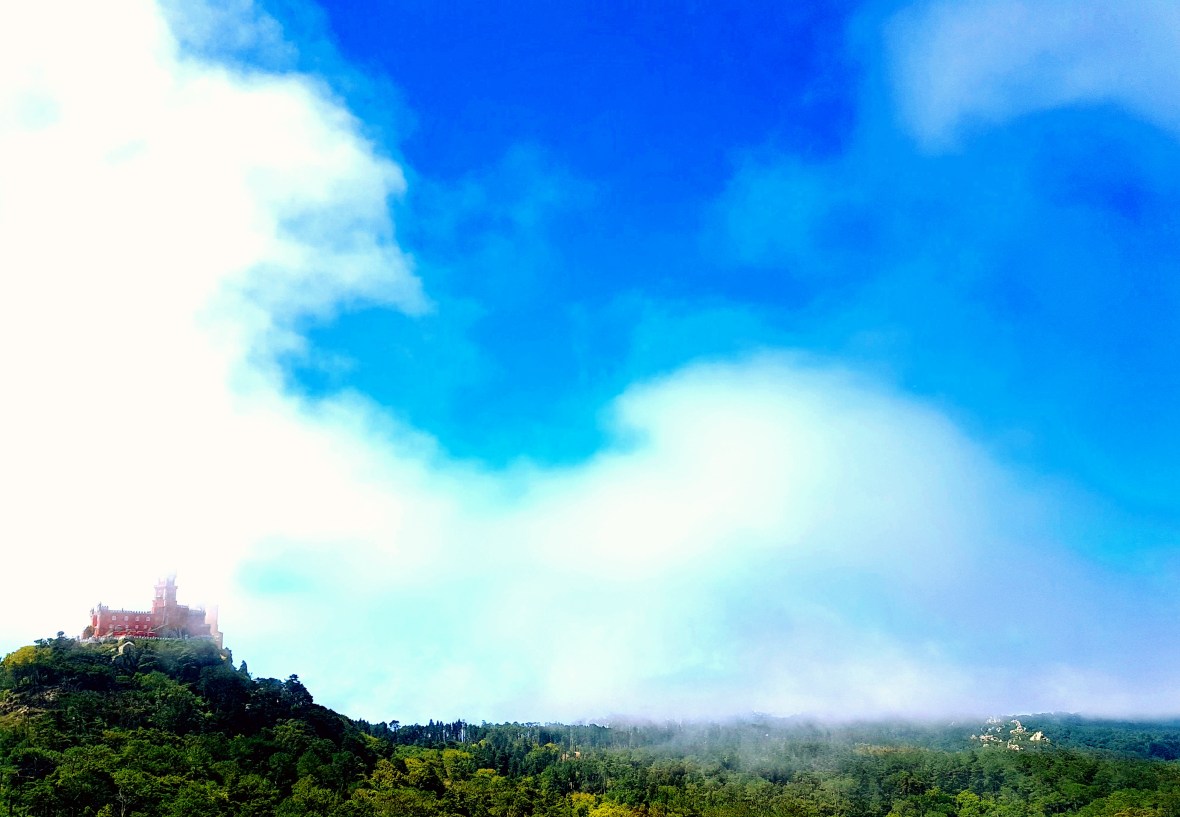
It took perhaps fifteen minutes of patience and tourist-dodging to capture a clear photo of Pena Palace emerging from the mist. In the next second, it was gone again.
Pena Palace
By the time we went to see Pena Palace, the sun was out proper, and so were the hordes of tourists.
From what I can tell, the palace is usually seen as the star attraction of Pena, and there’s good reason for it to be the Headliner image of Sintra. The palace is something straight out of a Disney movie, and I swear I completed a GCSE art project once that unconsciously turned out to look eerily like it. (It was a pop-up 3D castle, thank you for asking).
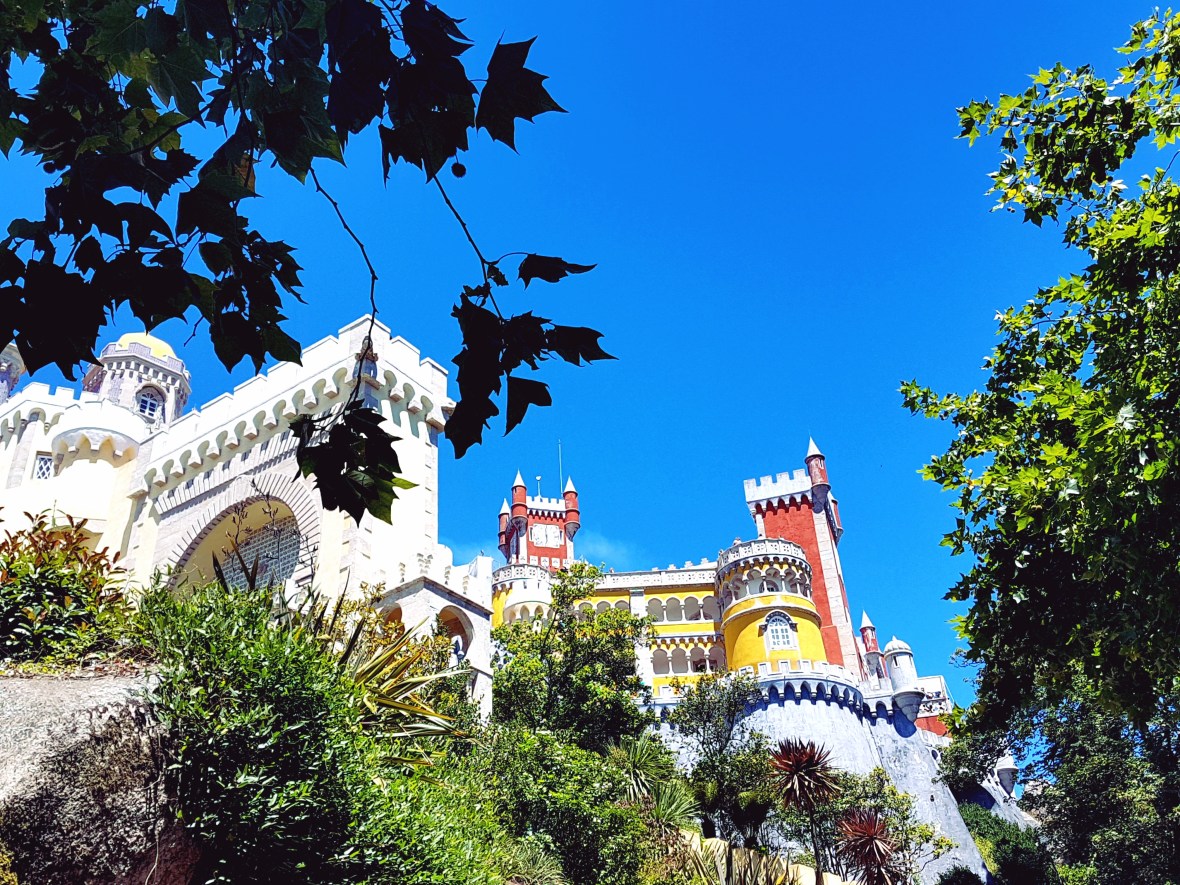
Dating from the 19th century, the palace was originally a monastery that got pimped up by King Ferdinand after it was ruined by the Great Earthquake of Lisbon of 1755 (yup, the same one). The architecture is of Romanticism (hence,Disney).
The queues to get inside snaked around the perimeter of the palace, with tourists thankful whenever they managed to shuffle forward into a shaded area or covered walkway. I was seriously considering not bothering, but then that classic case of curiosity got to me (“if they’re all queuing for this long, it MUST be good”). It doesn’t work for me when considering Japanese baked cheese tarts, but I was only going to be here once so we decided to go along with it.
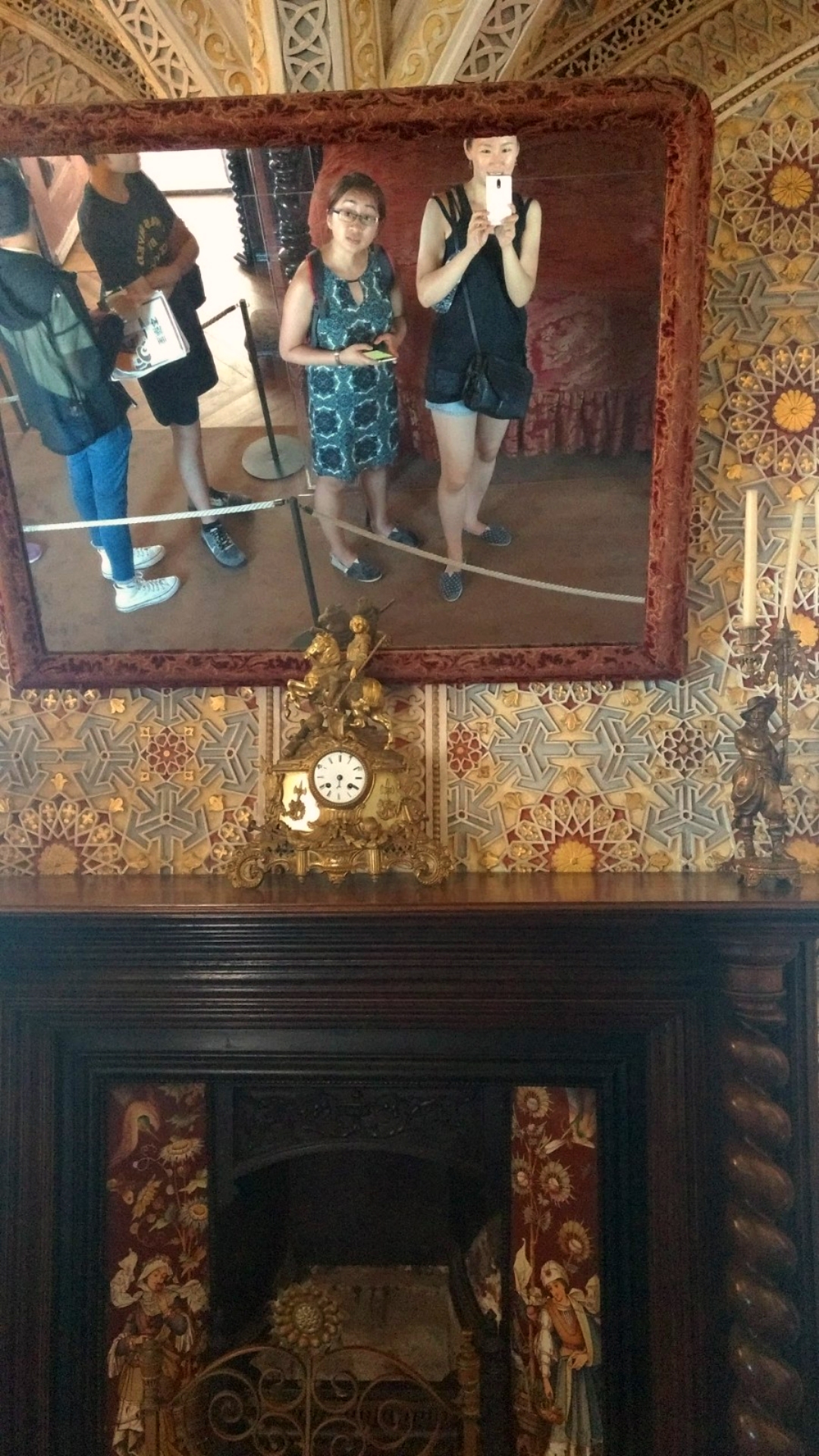
Oh hai
Since there were so people there, whilst the rooms were nice (what you might expect of a summer residence for the Portuguese Royal Family), a lot of it was us shuffling along in a line between velvet ropes, glancing at the elaborate stucco patterning and mahogany furniture. Again, at the risk of offending multiple nations, the touring was reminiscent of a gander around Buckingham Palace, what with the ‘spacious-elegance-with-an-air-of-pretentiousness-and-we-have-more-money-than-you’ feelz.
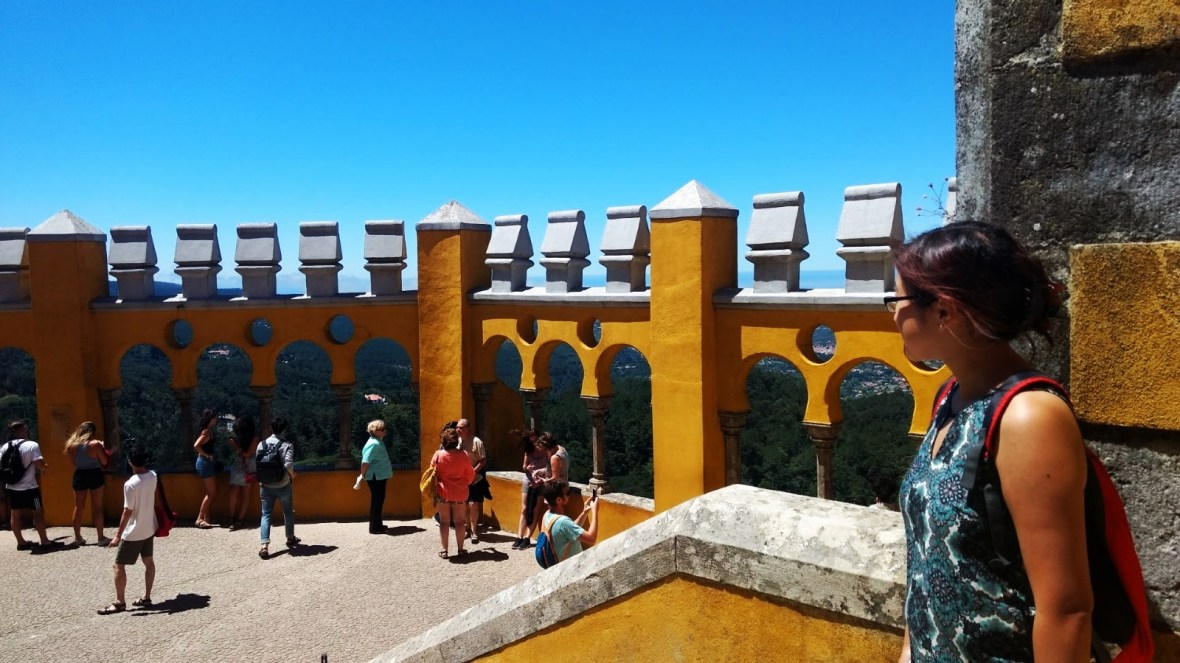
I much preferred walking outside and around the palace grounds – the stark vibrant colours and bold clear lines were a refreshing contrast to ye olde crumbly bland bricks type o’palaces, and the area was large enough to have and enjoy your own corner of the palace, looking back at Castelo Dos Mouros or peering towards Lisbon (Pena Palace itself is visible from Lisbon on a clear day).
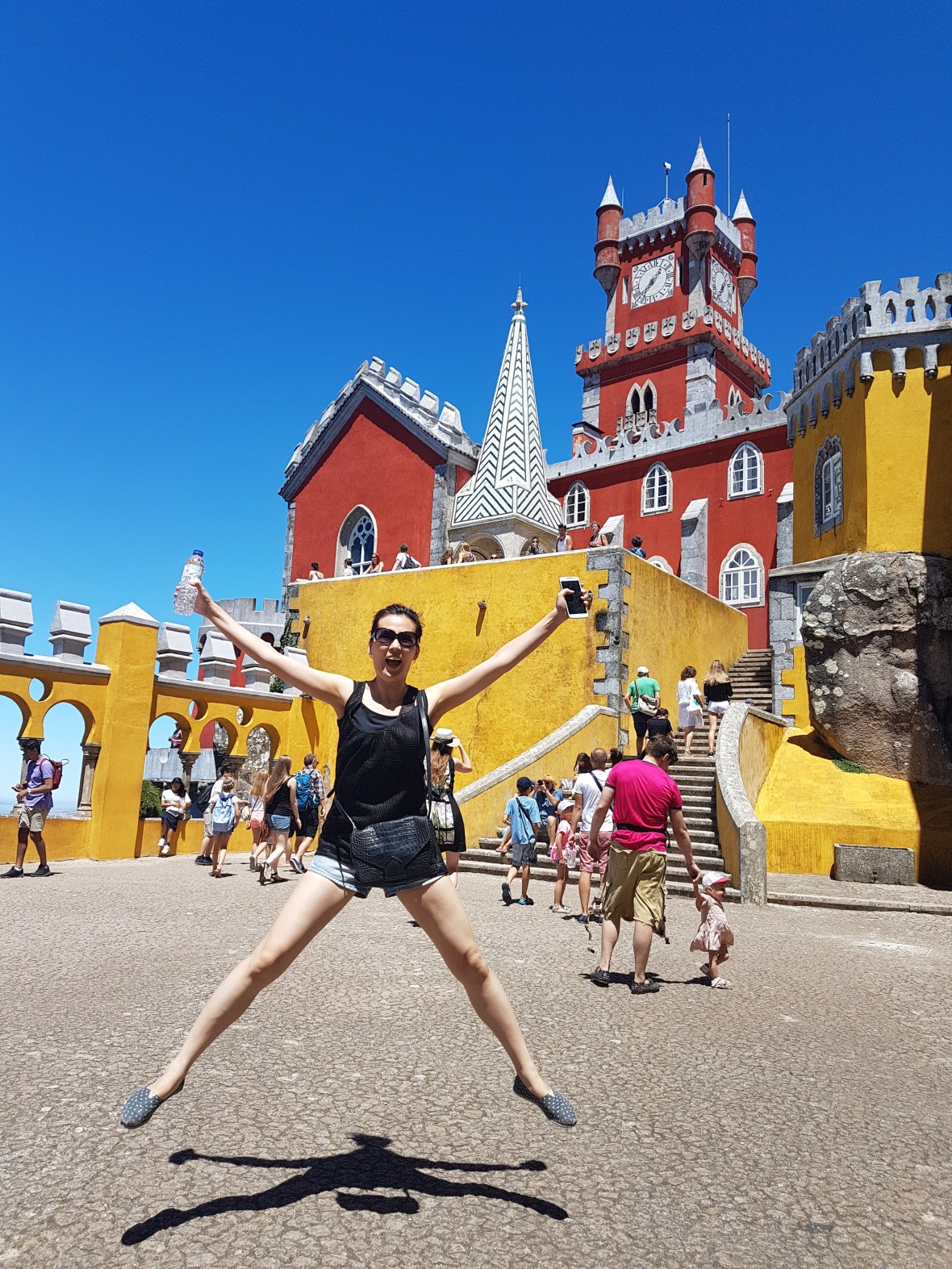
Sian seemed to enjoy it.
Quinta Da Regaleira
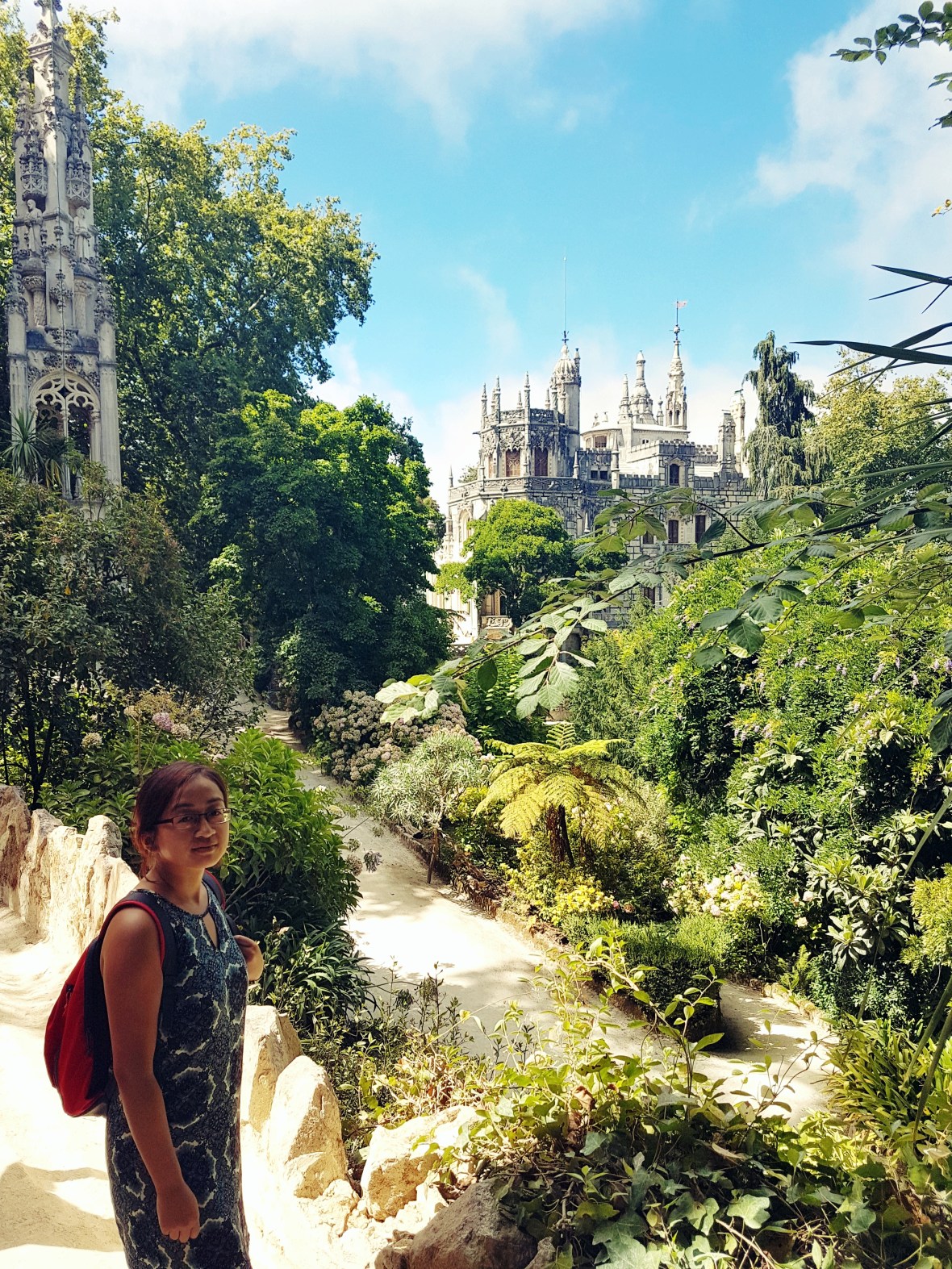
Our final stop in Sintra was the enigmatic private estate of António Carvalho Monteiro. Not known for any particularly historic reason, it’s simply a fascinating and magical place full of grottoes, wells, fountains, parkland and gothic architecture. The guy even commissioned his own ‘palace’ and ‘chapel’ within the four hectare grounds. It wouldn’t have gone amiss in a Tim Burton movie or perhaps as the setting of ‘Dark Alice in Wonderland’. I suspect ole Tony was a bit of a raving eccentric (and I thank him for it).
Take for instance this view of the Waterfall Lake, complete with its series of tunnels and caves.
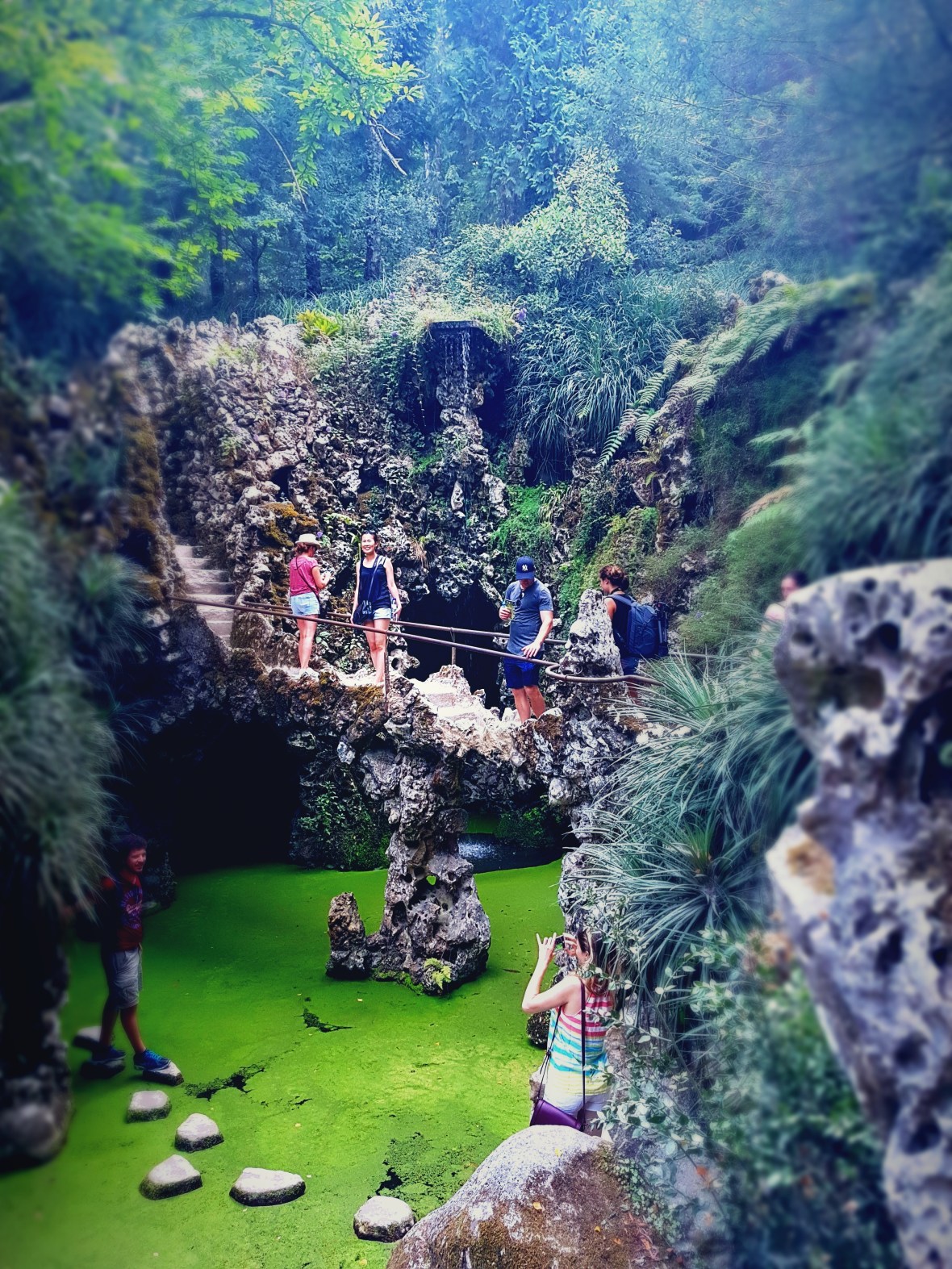
Stone bridges crossing green mossy lakes amidst the backdrop of small waterfalls – there was no way to get an undisturbed picture of such beauty.
At times, walking through the estate felt like walking through a dreamscape. Lush greenery, gothic fountains and benches carved into the walls of the garden trails, it felt a stepping into an open immersive theatre experience of enchantment and imagination.
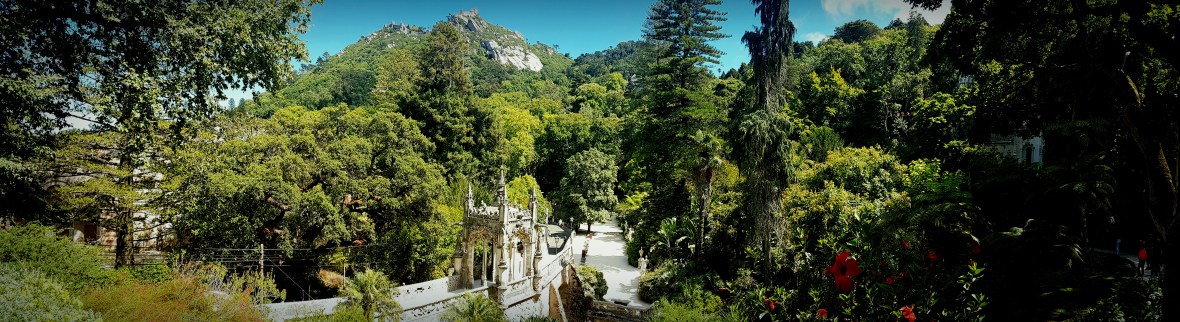
Trees and flora cram almost every inch of the vista when walking through the estate’s parks and pathways
My utterly favourite part of the Quinta, was visiting the Initiation wells. I had read about these before our visit and I was super hyped to go see them.
Whilst they are called ‘wells’ there was never any intention to hold any water in them. Instead, our eccentric owner was understood to use them for mystical Tarot initiation rites. The larger well contained a long spiralling staircase that covered nine levels. It is said that Monteiro intentionally asked for this in order to depict the scene in Dante’s Inferno which described the nine circle’s of hell, to show the descent down the staircase as a literal and metaphorical descent into Darkness.
In case anyone was interested, here are those nine circles in ascending (or perhaps more accurately descending?) order of Hellishness
- Limbo; Lust; Treachery; Fraud; Gluttony; Greed; Heresy; Violence.
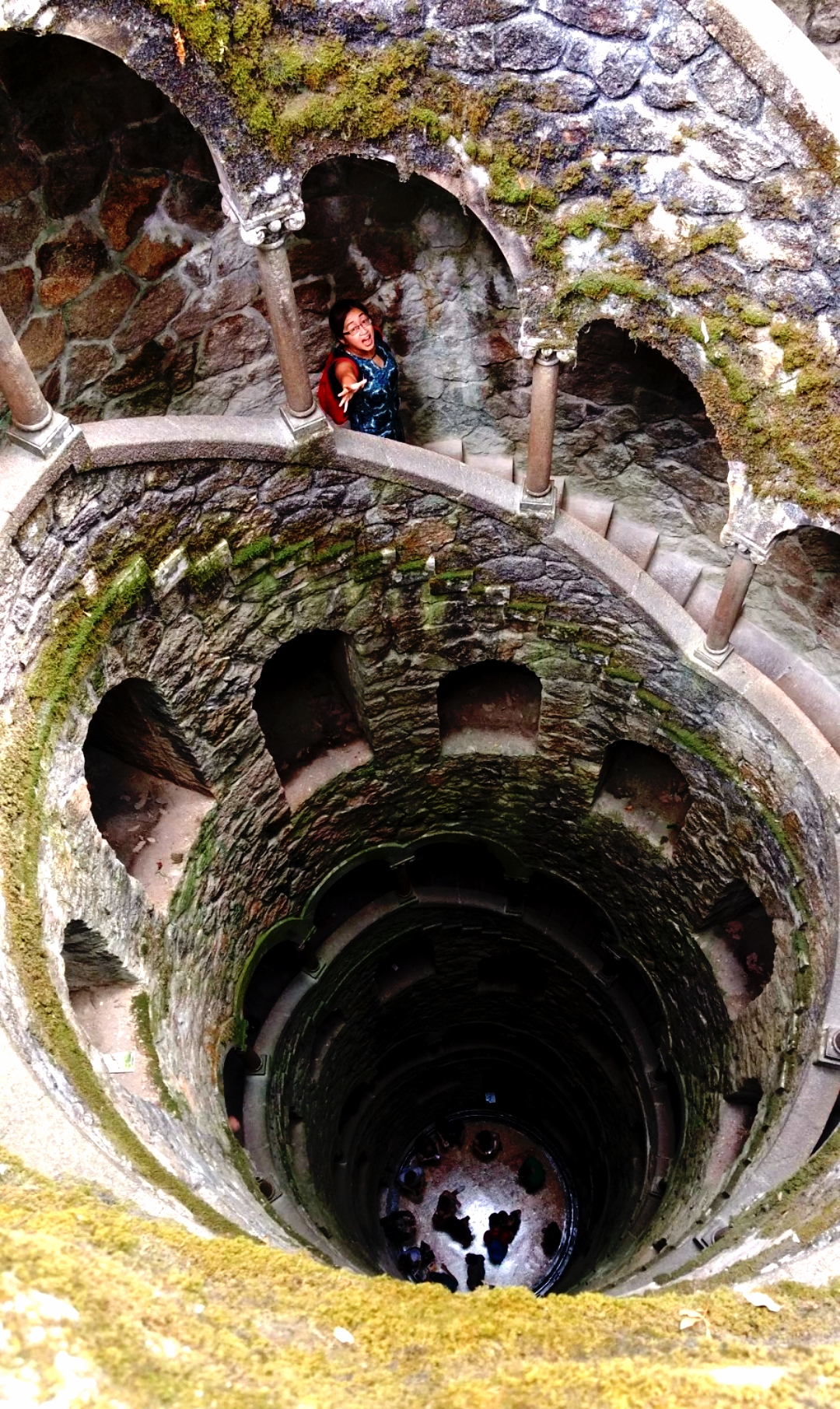
The staircase doesn’t really have a one-way system. As such, you can actually choose to descend into ‘Hell’ , or if you choose to take a more positive interpretation of Dante, and Monteiro’s musings – you can start from the bottom and ascend up the ‘9 spheres of Heaven’ as described in Dante’s final chapter of the Divine Comedy, entitled ‘Paradiso’.
The nine spheres, also known as the nine levels of the Angelic Hierarchy, are:
The Moon; Mercury; Venus; the Sun; Mars; Jupiter; Saturn, the Fixed Stars (the outermost edge of Heaven that is visible), and the Primum Mobile (the invisible edge of Heaven, otherwise known as Crystalline Heaven).
I spent more time here than I typically would spend to gawking at a well. As well as (heh) it being highly picturesque, (I spent an age at the top attempting to take a photo that didn’t look like it was highly infested with human-sized termites at the bottom), I lingered at almost each level of the staircase to marvel at the sight above and below me as I descended slowly to the very bottom. (yes, I choose to descend into Hell, but that’s because I couldn’t/couldn’t be arsed to find the tunnel to enter at the bottom and climb up into Heaven. Does laziness count as one of the nine levels?)
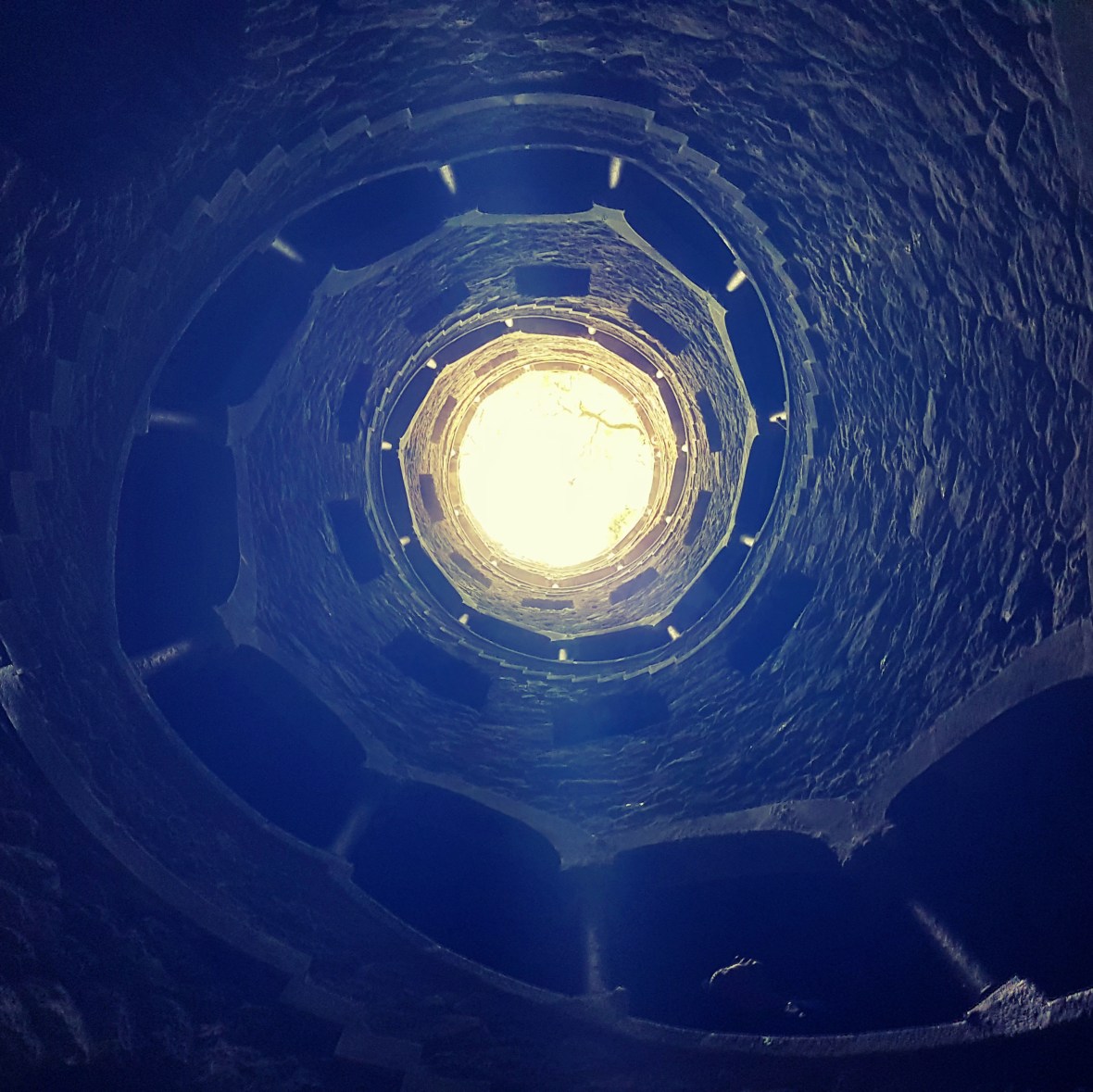
If you make the effort, light awaits…
So here’s how much I liked the place – 1.5 years on, when I got around to actually finishing this damn blog post – I googled ‘Sintra Quinta’ , paused at the auto suggestions and clicked the entry that said ‘Sintra Quinta Wedding’. The estate is an absolutely beautiful place for a wedding and although I don’t have any particular reason to get married there (I wasn’t born in a well, for instance) it is as romantic and charming a location as I’ve ever seen, plus I could reasonably fly most of my family over there…especially if they were big fans of Easyjet. Now, there’s just the small issue of booking out the five hectare UNESCO World Heritage site venue..
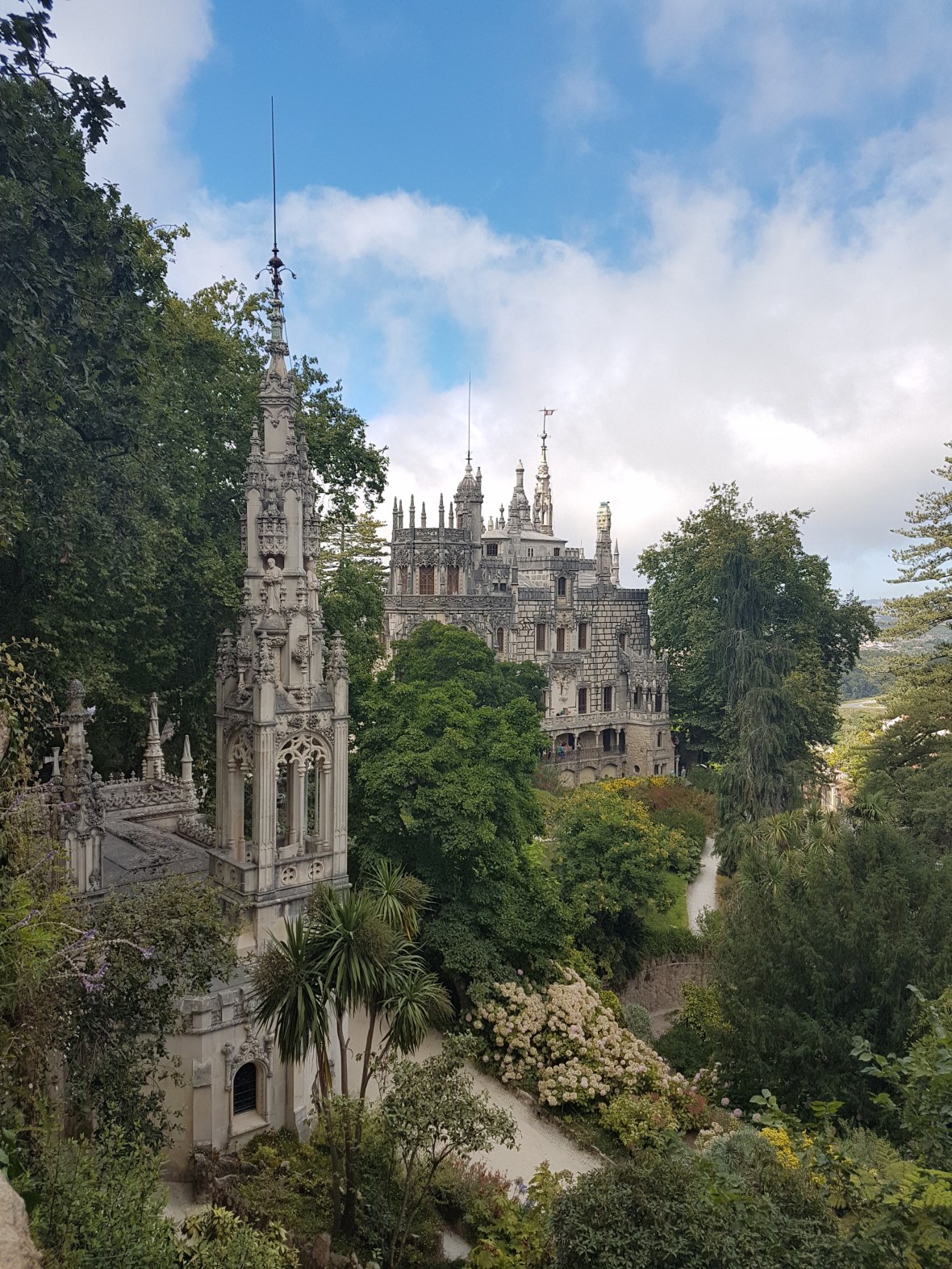
Will and Kate, Harry and Meghan.. y’all ain’t got nothing on my wedding plans.
The last city on the Portugal tour wasn’t anything to be sniffed at – the capital itself, Lisbon.
I feel like I needed to have spent more time in Lisbon to really appreciate it. For me, it felt like one of those perfectly lovely cities, electics, full of life and good food and fun bars, just not the best “anything” kind of city. That sounds harsh, and that’s why I think it’s a sort of city that pleads you to stay a summer, or a year – not two days – any amount of time where you get to really soak it in. It’s likely the kind of city which doesn’t wow you in one particular regard, but it’s just fantastic to live in and you gradually feel affection and fall in love with it. I liked Lisbon, a lot, in fact. It had colour and edginess, and not necessarily the sort of edginess that has you panicking as you walk down a dark alley. But it’s comfortable being what it is, letting her more famous cousins, Madrid and Barcelona, take the spotlight and the headlines whilst it just chills in the corner, sipping a bottle of Super Bock.
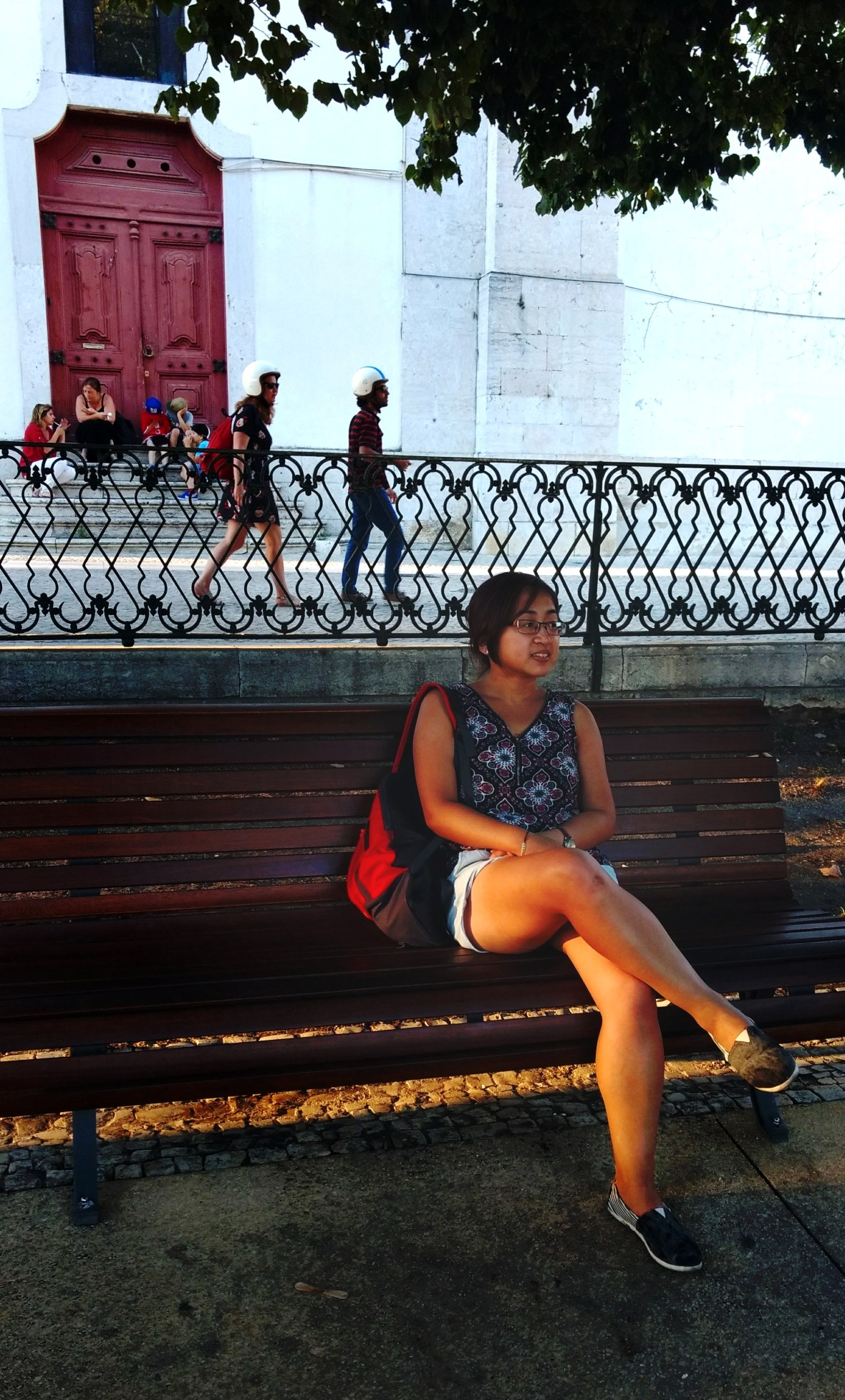
Missing the bottle of Super Bock but just chilling in the lazy sunlight
The most famous neighbourhood in Lisbon is Belem. Home of the famous Belem Tower, the Jerinimos Monastery, and the legendary Pasteis De Nata (oh yes we’re back on that now).
The Belem Tower is often the iconic emblem of Portugal, evidenced by all the guidebook covers it usually adorns (why don’t they put an egg tart on the cover instead). What started as a small and elaborate fort is now a Lonely Planet favourite, and ideal place to practice your star jumps.
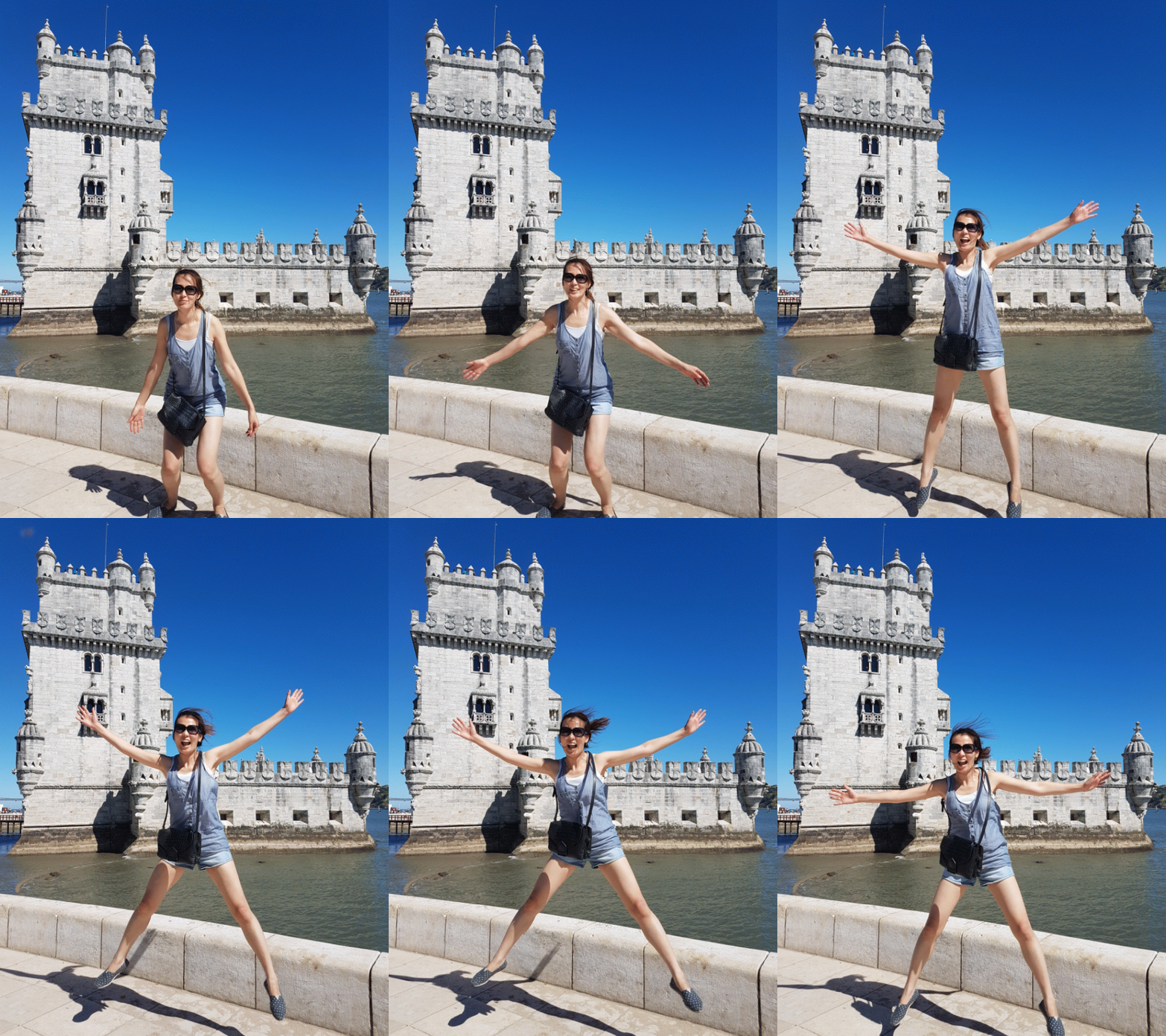
I’m exhausted just looking at this
An activity that’s fun for all the family, is queuing with the crowds to buy an egg tart from where, reputedly, it all started – at Pasteis Balem. It took us several minutes just to figure out how to enter the shop (there were at least two queues at two different entrances, as well as a stream of people who were casually entering through the main door), but whilst we hedged our bets and I stuck it out in one of the random queues, Sian emerged triumphant with two egg tarts in tow. (Am I allowed to use ‘in tow’ in relation to egg tarts? The internet says ‘ under close supervision/in one’s charge’.. but I’m pretty sure it can’t be used in relation to tarts. Not these types of tarts anyway.)


Something might have happened to the egg tart between the taking of these two photos
Tart verdict – sweet, delicate and lovely and gooey. If I had to pick though, I’d still have to go with the ones I had in Porto – it might have been the fact they felt like they were fresh out of the oven but they were also a tad less sweet. I’d gobble them both up if you gave me either though, just sayin’.
My feelings on churches, monasteries and the like are relatively straight forward – they can be very grand, ornate, impressive and even majestic – I can quite happily all of those words readily and agreeably, but I use them in the most technical, objective sense because I don’t feel anything more towards them – I don’t feel any religious empowerment nor any deep passion for architectural or engineeering feats. Thus, whilst I walked and meandered through the pews of the Church attached to the Jerinimos Monastery, I took very few pictures and none of which were very good.
I will therefore steal copyright from Sian (except I’m name dropping her so it’s not stealing, right) and post this photo, which was much better than anything I took and does indeed qualify the building as majestic.
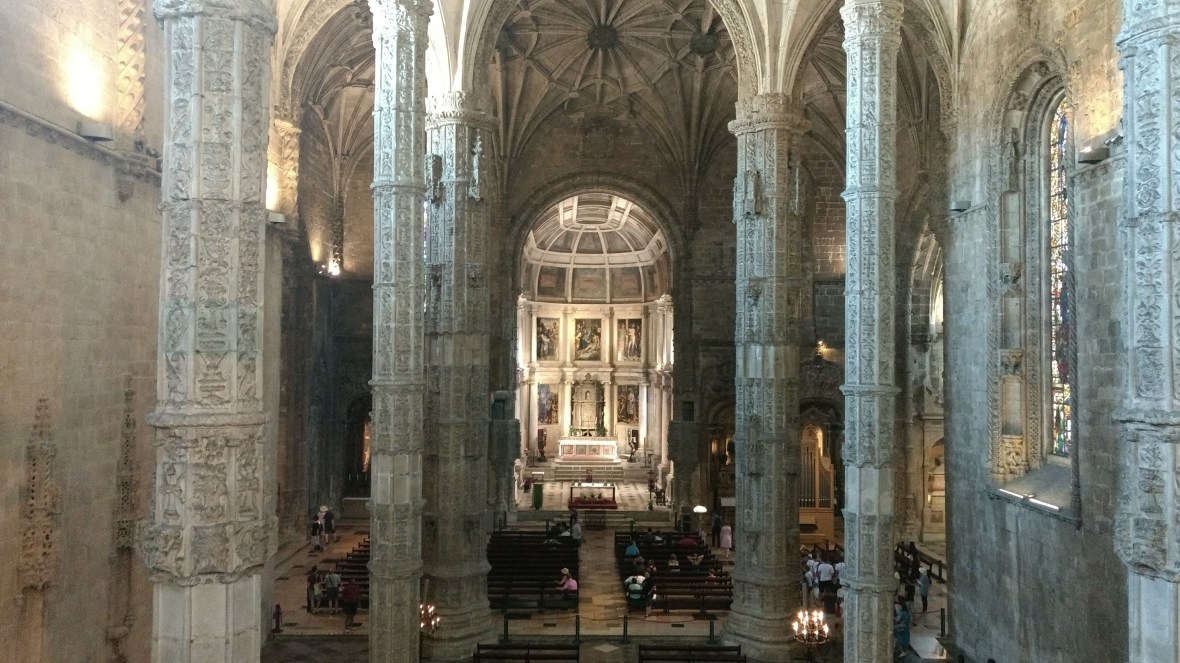
An interesting little find (at least I found it interesting) was that the tomb of Vasco De Gama can be found in this Church.
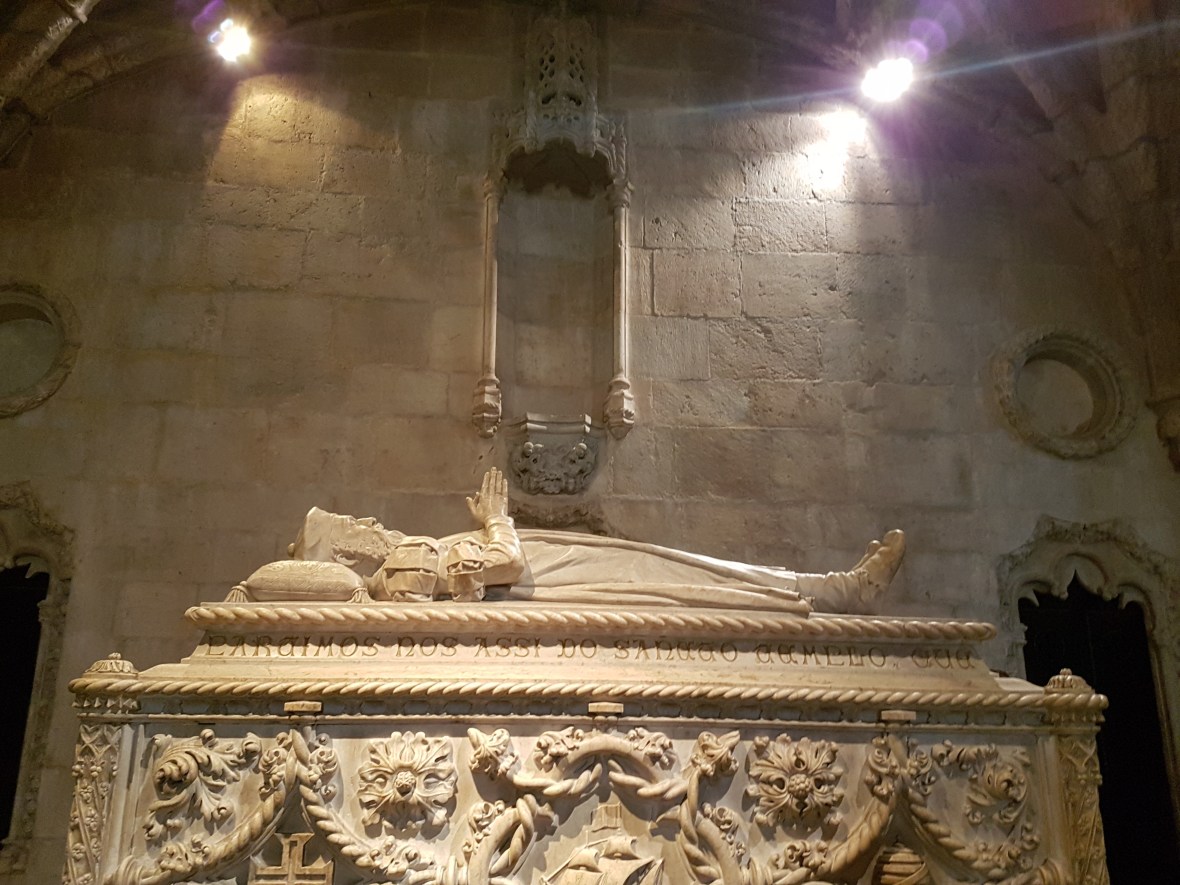
Tomb of Vasco De Gama – died in Kochi, and interred in Belem
You may know Vasco De Gama as one of the greatest Portugese Explorers of his time, in the Age of Discovery. He lays claim to the first successful sea voyage between Europe and Asia – essentially opening up the door between East and West for the very first time in known history. As such, he was one of the early pioneers in establishing Portugal’s burgeoning colonial power in the East.
Otherwise, you’ll probably know him as a name of a Brazilian football club (they’re not bad). Eitherway, both facts underline the fact that this was a notable and impressive individual.
Outside of Belem itself, I discovered late on in the trip that Lisbon held a musuem dedicated to one of it’s favourite sons, and my favourite author – José Saramago.

Saramago won the Nobel Prize for Literature in 1988 and whilst he died in 2010, his are the kinds of books which are perpetually relevant, as they relate to the hypotheticals of the human condition and the order of society.
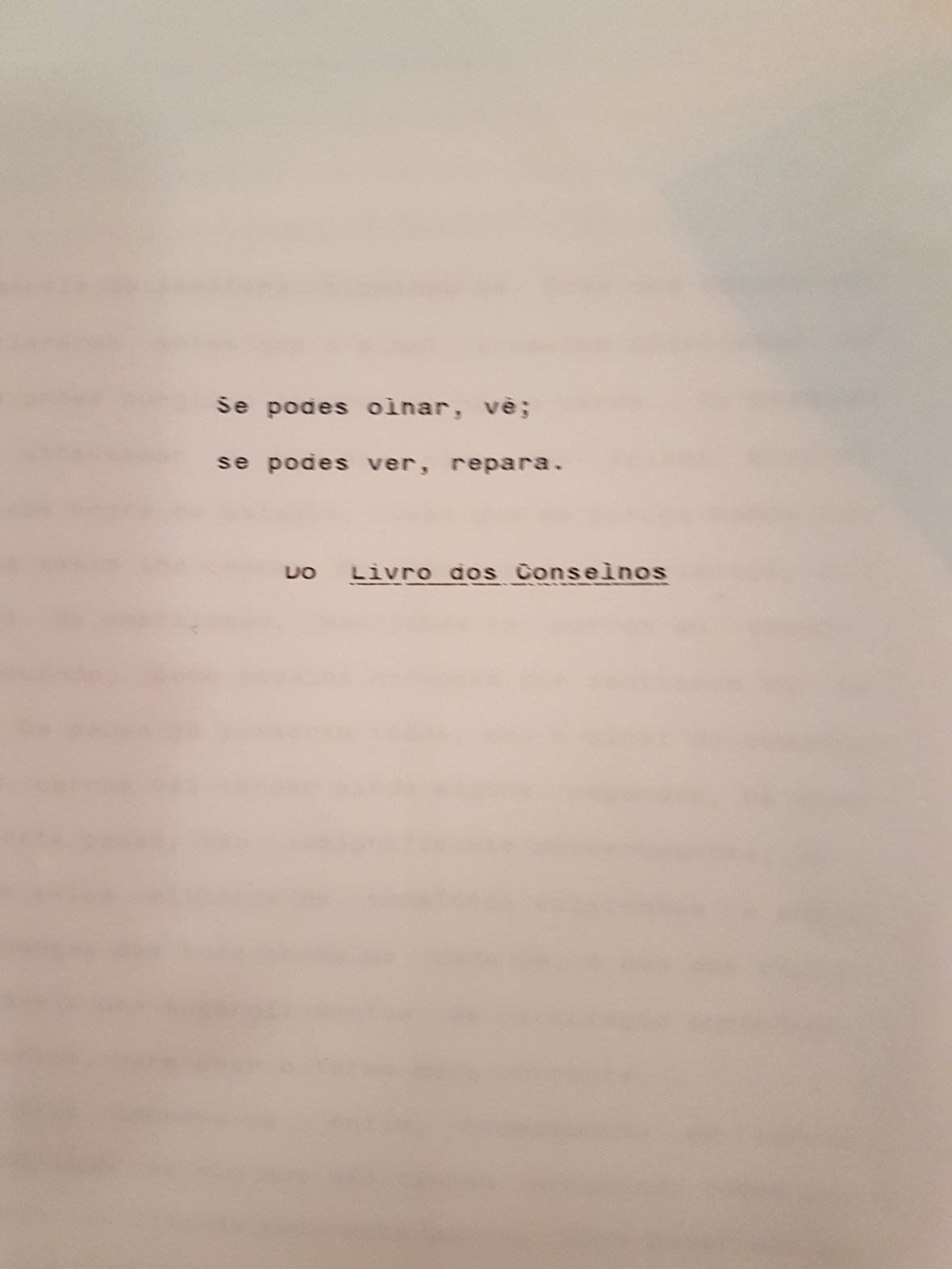
The manuscript of my favourite book, “Blindness”. The front of this manuscript reads “If you can look, see – if you can see, notice”
Without trying to turn this blog post into a promotional campaign poster, Saramago’s books never have named protagonists in order to avoid characterising these individuals as mere book material – they are you, they are me – they are anyone and everyone around you. The narrative is often ludicrous (an entire city goes blind, the votes of an election are all cast blankly, an entire town where no one dies) – but they serve to illustrate the innermost, barest and vulnerable instincts of mankind. When governance, natural selection or power deserts us, Saramago likes to wryly, satirically and often poignantly, point out how we regress to what we ultimately crave the most- the need to connect. Also, he writes in extremely long sentences that don’t often contain commas nor even punctuation until the end of the paragraph, so whilst it’s heavy lifting to get used to, his style is undeniably unique.
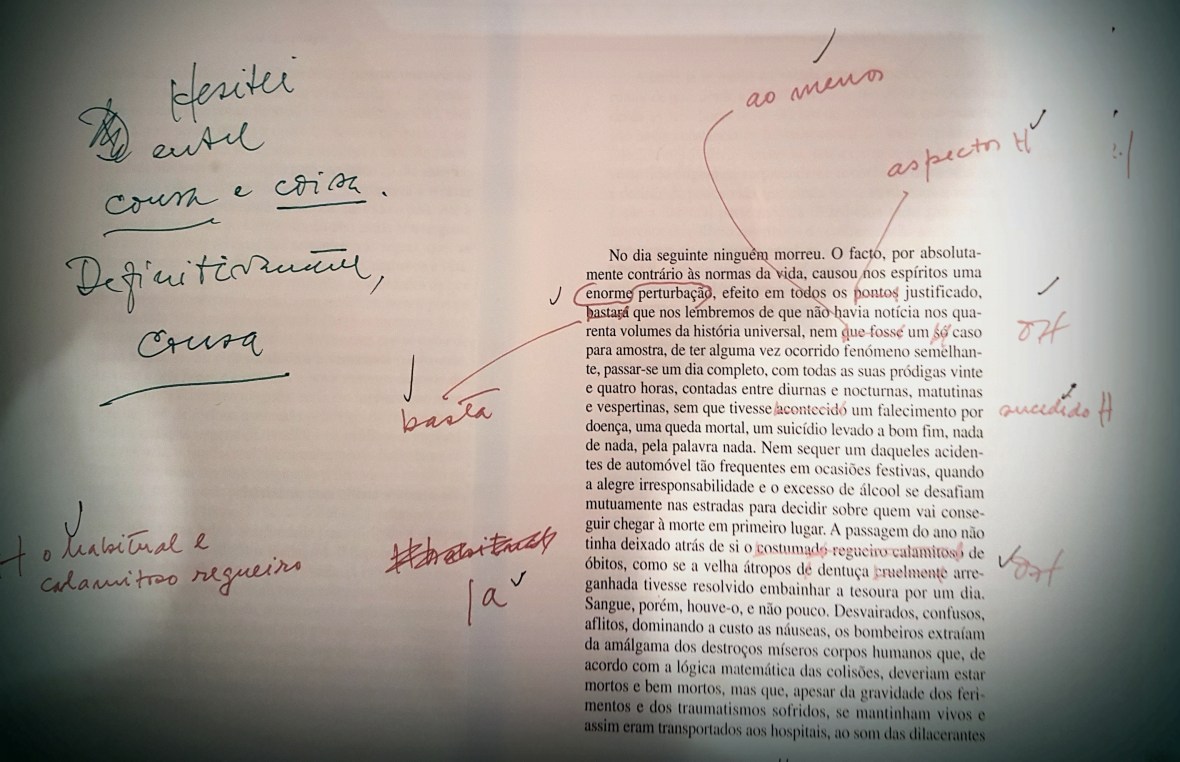
The first line reads “On the next day, no one died”. The manuscript to “Death, with interruptions”. The book deals with the end of Death – (he’s actually a character) and how following initial celebrations, people then start to question what this means for society, the economy and religion.
The musuem (foundation, more accurately) was pretty cool, though in reality it was just covers of his books translated into various languages, stuck onto the wall. As well as a few of his original manuscripts, there was a room decked out to resemble his own study, complete with his very own typewriter and spectacles neatly laid out on the desk. It may not be on everyone’s Lisbon hit list but this was a small little geek-out moment for me, and was my version of an avid Harry Potter fan visiting the beautiful yet far more tourist-crowded Lello bookstore in Porto. I have been halfway through one of his earlier, less famous books (‘Skylight’) for over a year now, and recalling these memories will make me pick it back up again tonight.
The city itself was a lovely place to stroll in.
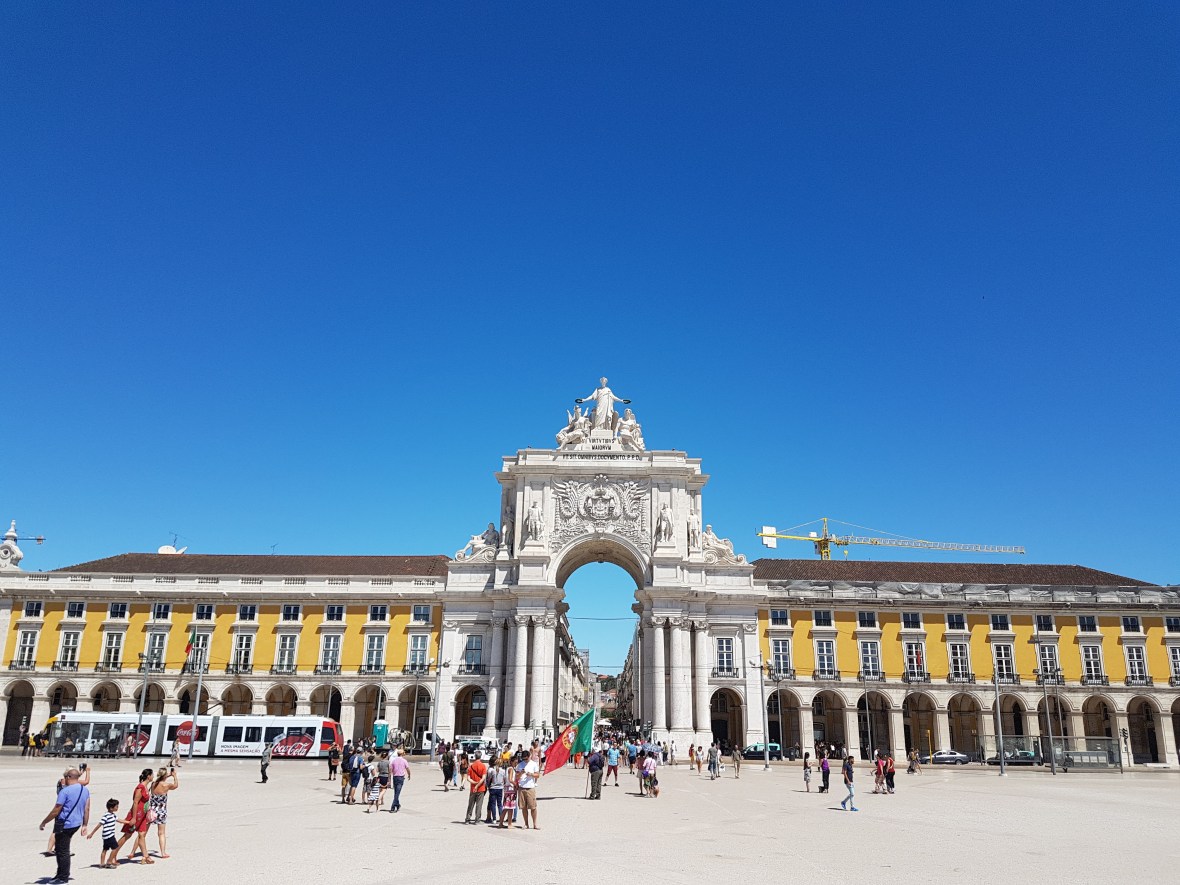
Praça do Comércio, or Commerce Square – gigantically huge, if that’s a thing,
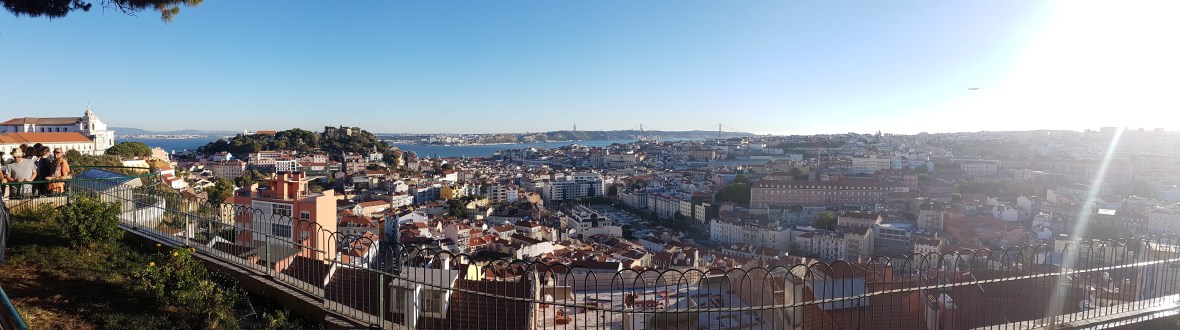
Lisbon panoramic in the late afternoon
The streets had that cosmopolitan cobbly-but not too cobbly feel that only Western European cities do. The building walls were occasionally graffiti’ed, occasionally historic, and occasionally both. As well as the grandeur of the main squares, the smaller, more intimate ‘bairros’ are the heart of Lisbon’s charm. (The most famous of the bairros is meant to be Bica, where Rua da Bica de Duarte Belo” purports to be “the most beautiful street in the world.” I can attest that it’s “ehh, OK”.)
As the sun set, the street lamps blinked into life, the cast shadows bringing a deeper allure and intimacy to the Bairros.
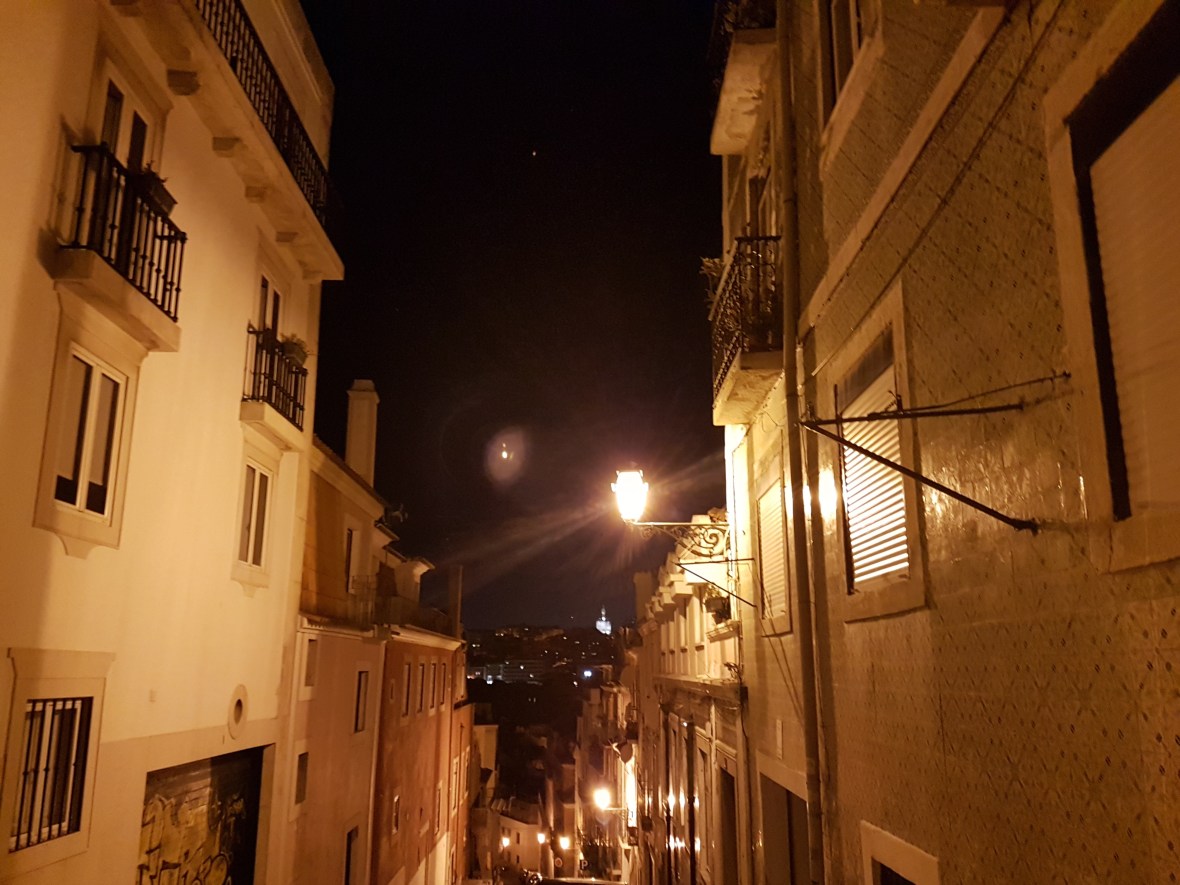
Not a great photo but the narrow streets and the gentle, amber lighting is exactly how I remember Lisbon and hence that’s why I’ve added this photo.
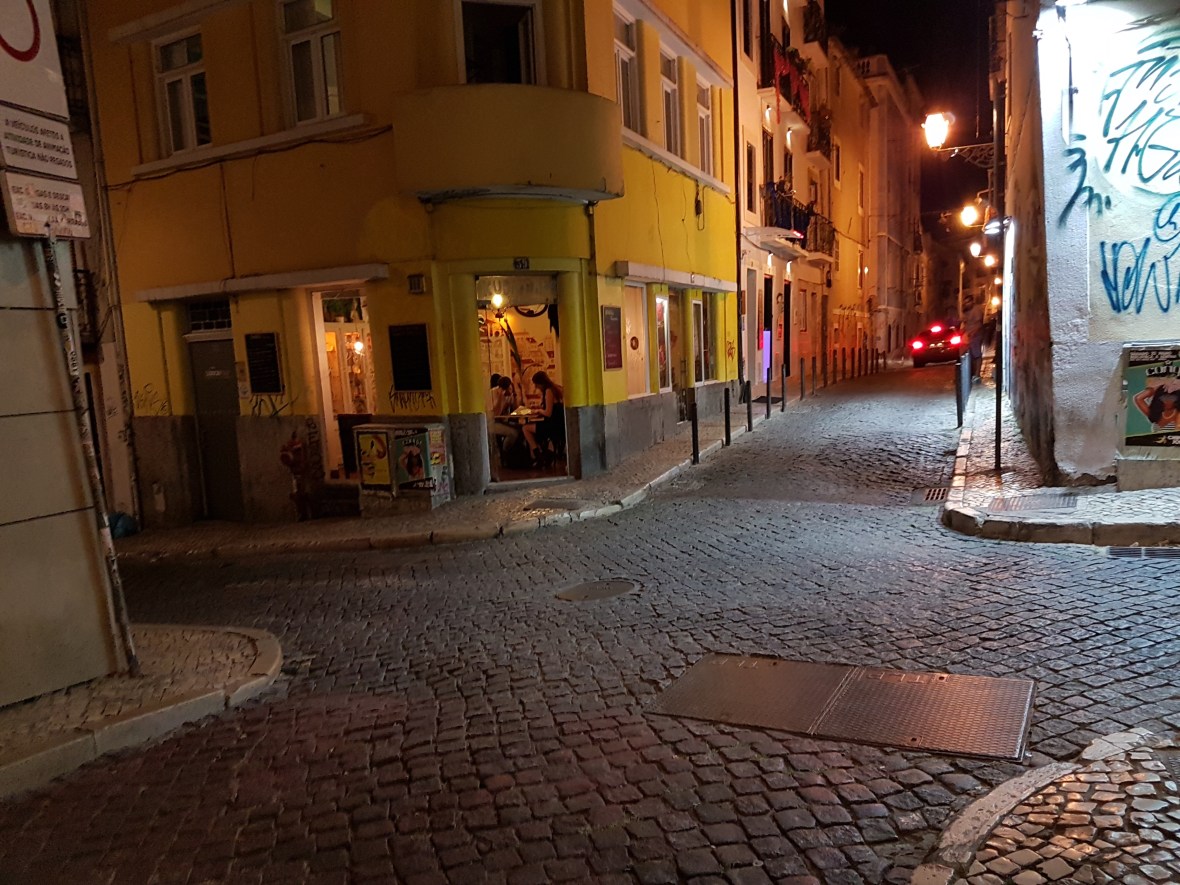
Again, a pretty plain photo but this is the junction where we stayed (the building seen in the near left) and in a couple hours it’s going to be utterly chock-full of twenty something Portuguese spilling onto the streets (evidently, their seating of choice) drinking cheap beers and cocktails.
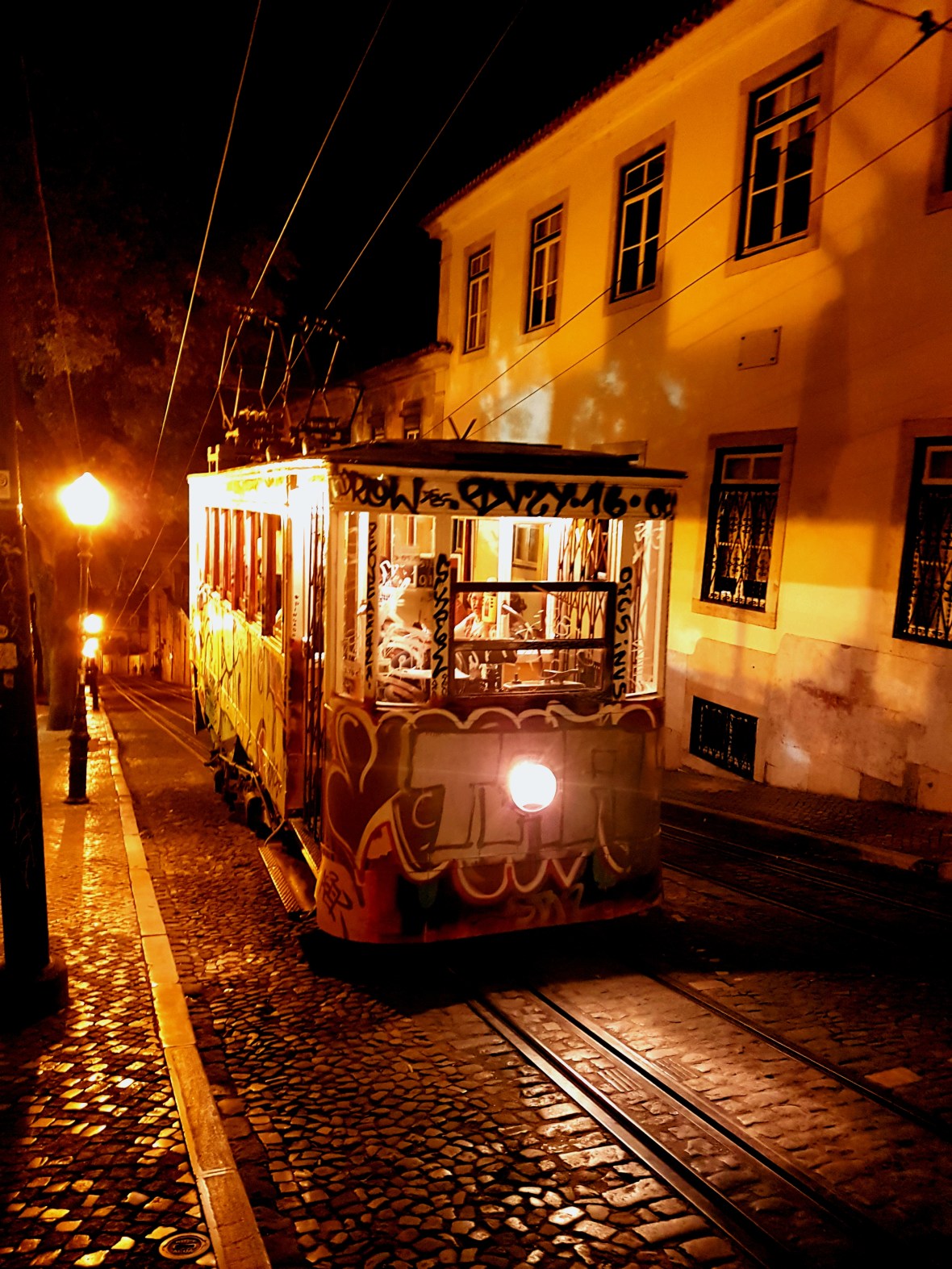
The famous Gloria Funicular -runs through what feels like only 100m of an steep slope – but tourists often take it just to get a view of the un-ending panels of graffiti that adorn the walls of buildings the tram passes through
The famous Gloria Funicular -runs through what feels like only 100m of an steep slope – but tourists often take it just to get a view of the un-ending panels of graffiti that adorn the walls of buildings the tram passes through
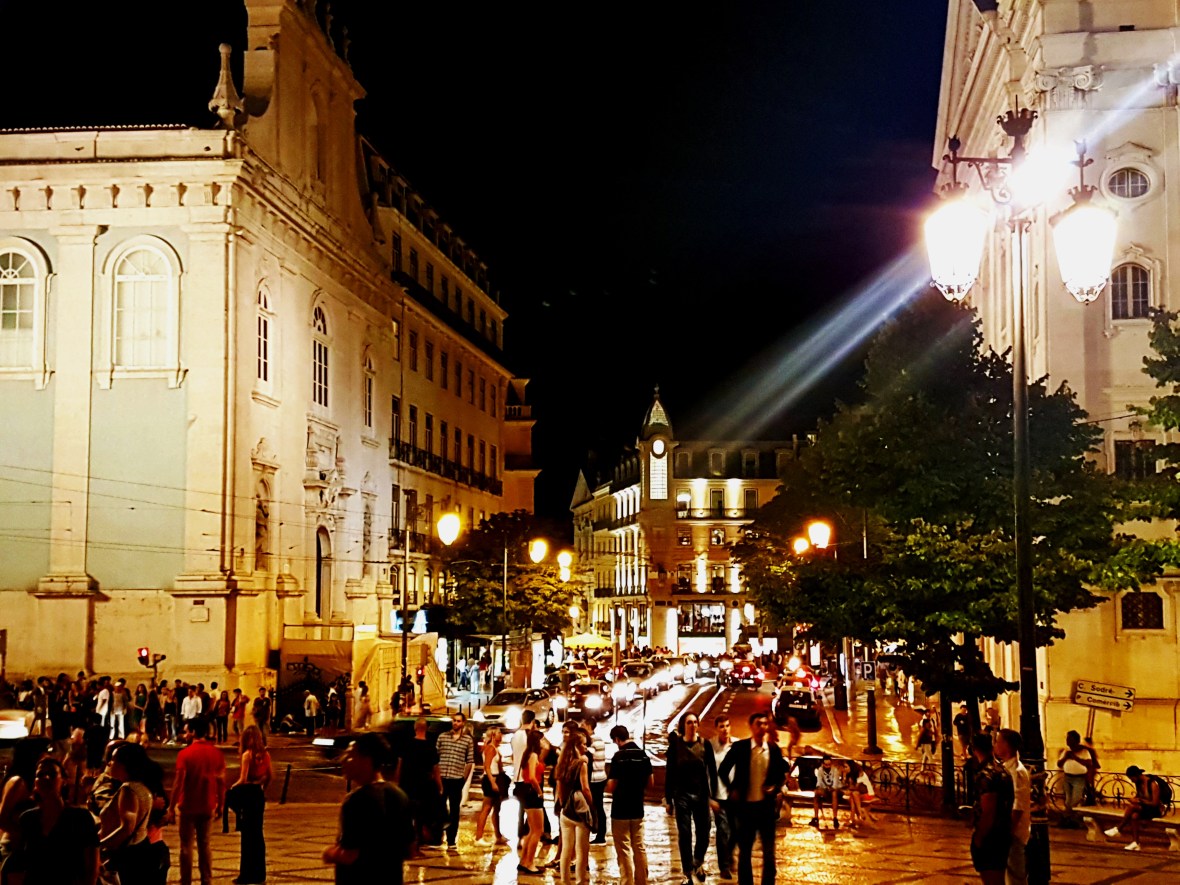
Near Rossio Square – the buzzing night-time atmosphere and crowds of youngsters admidst an elegant backdrop of tall, regal-like buildings are reminiscent of my short time in Madrid.
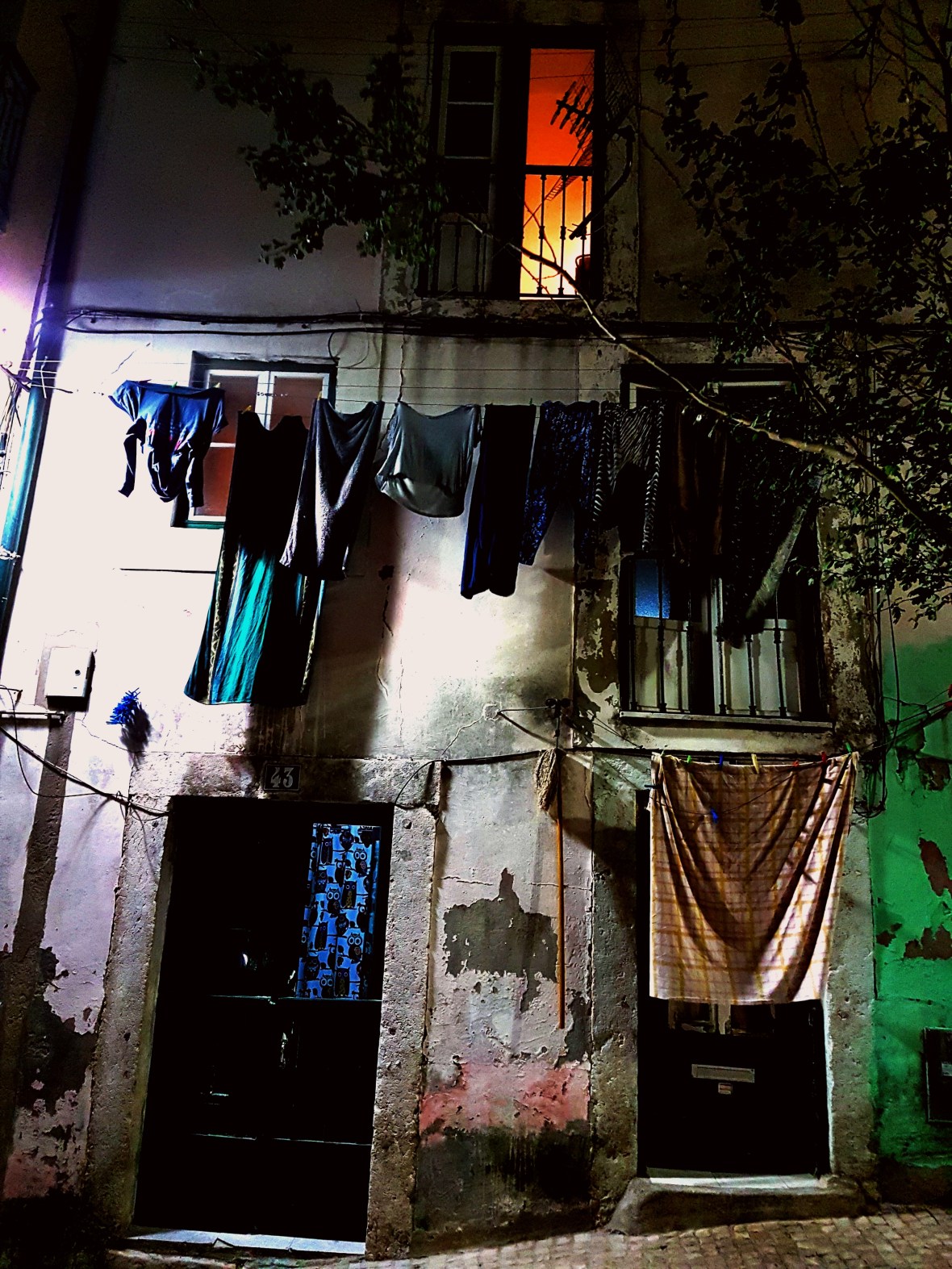
Laundry hung out to dry in the centre of the city – a reminder that for all it’s elegance and history, Lisbon is siimply where some people just call home.
Our final dinner in Portugal was at Taberna Da Rua Das Flores, and I would certainly go there again. The menu is changed everyday, scrawled on a giant chalkboard that the waitress will haul to your table and take you through (or stone steps, since we didn’t reserve a table as was suggested, but it sure made for a fun dining experience, Not even the positioning in front of the toilet could ruin it). Fresh seafood, steak, pork and all sorts are served tapas style in a variety of different ways but always stylishly and tastily. We drank white and red port, and gorged quite happily for a decent price and delicious food. Very much recommended, although I’d be inclined to think there is a plethora of wonderful restaurants in Portugal generally.


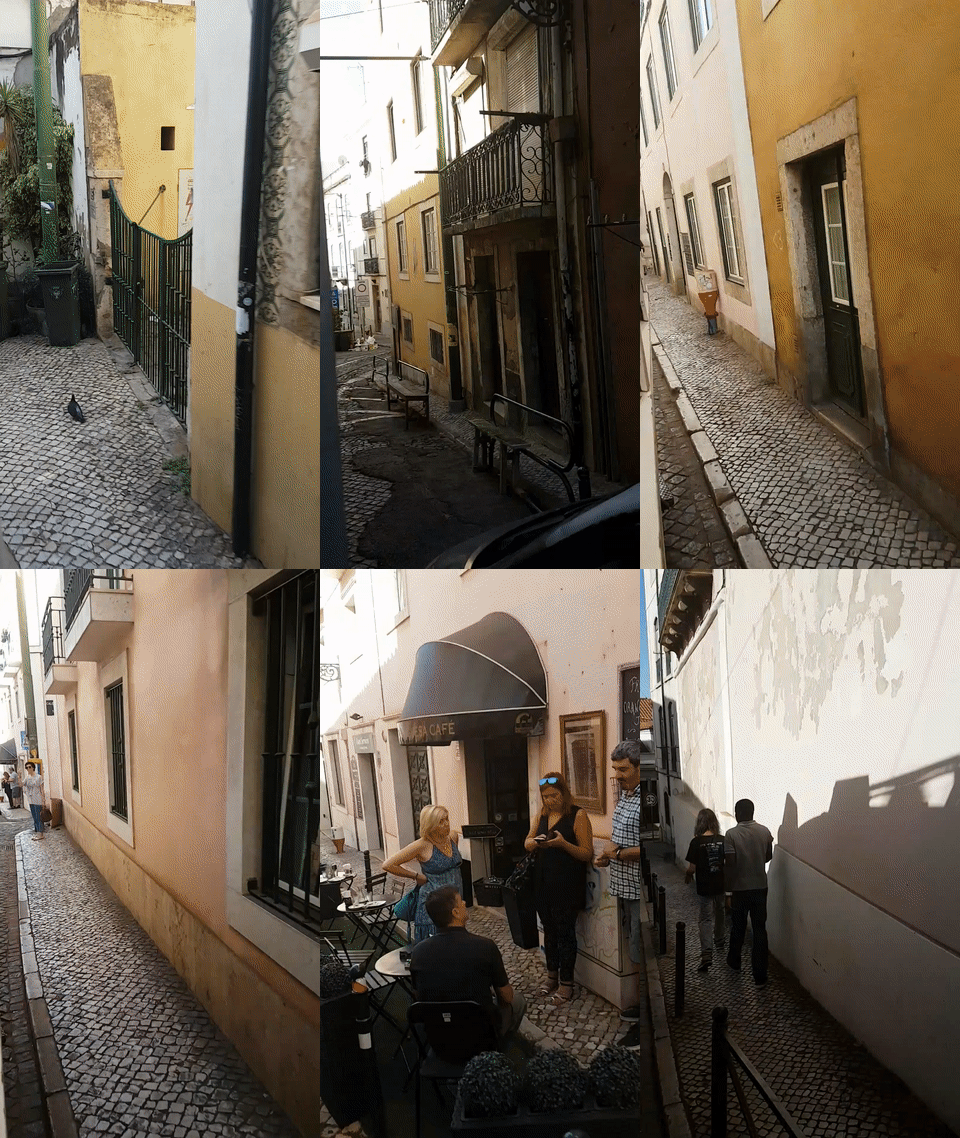
What’s left of Lisbon, is Tram 28 – the famous train line that runs through the heart of the city, stopping at all of the usual tourist stops. Such was its popularity, the queue to get on may well take longer than the journey itself (who doesn’t love a tram ride eh?). We deliberately yomped all the way out to it’s starting point at Campo Ourique to bag a seat, and still had to wait for several trams-worth of tourists to get on first. Luckily, we were at the head of the queue when the next tram rolled in and we bagged some choice seats by the window.
-

Yeyyy window seats on Tram 28!
It was a beautiful and enjoyable holiday (look at my tan!), and thanks Sian for being an awesome travel companion! I have incredibly fond memories of the country that I so often neglected in place of its more famous neighbours, for so many years – I am glad I made it there eventually, and I hope I’ll make it there again. (If anyone I know is getting married, may I suggest Sintra, and make sure i’m available that day, mmkay?)
So in (FINALLY) signing off on Lisbon – and Portugal – who wants to take a tram ride with me..?
 KJK
KJK 