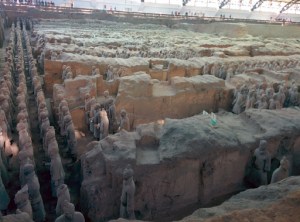
China for tourists: Xi’an

We’ve come a long way, baby.
.
Not in terms of distance to destination. After all, I live in Hong Kong nowadays and it’s just a hop, skip and step away from China. But, er, in terms of chronological timelines. I have after all, completely circumvented my holidaying in Turkey, Japan and Korea to get to this blog. My simple logic being – China is still fresh in my memory, and if I continue to bloody mindedly follow the chronological logic, it’s just gonna go the same way as the others – i.e. into a cognitive black hole. So let’s begin shall we?

The Visa convolution
First off, getting a visa from the China Embassy was not easy. Not for me anyway, because let’s face it, if there’s ever a simple process to be followed, I’ll be the one to make it exceedingly difficult. It took me three attempts to even get through the doors (carrying a Badminton racket? Nope you can’t bring that through. An empty water bottle? Nope can’t bring that through.) Naturally, it must be because Badminton rackets are classified as terrorist weaponry, and empty water bottles can be filled with the flammable liquids upstairs that they keep right next to the immigration forms. And then having made it upstairs, I made the rookie traveller’s mistake of not bringing a PEN, and even more laughably I had brought the empty application form, not the populated one I had already filled out at home. It appears pens are as rare as African Rhinos in the China Embassy. The clock room staff did not possess one. (They used pencils. Just to spite me, I’m guessing). The guard, who checked and MARKED WITH A PEN everyone’s forms, allegedly, did not have one. At least that’s what he told me, when I stared incredulously down at his pen held rather obviously in his right hand. So instead, I resorted to the kindness of (white) strangers, furiously scribbling down as many of my details as possible on the application form until their number got called up, they went to the desk and I went in search of another pen. And then I was told you needed photocopies of your ID. Oh they don’t tell you this on the website. Why should they, when you can be exploited for chump change using the one working photocopier in the Embassy building. Oh, and when I finally got to the desk, I was turned away because you needed paper evidence of flight details (Another neglected mention from the website). You can’t email them, nope. You can’t shove your e-itinerary on your mobile phone in the face of the desk clerk, no. You get turned down flat, b*tch. And so, all in all, the first trip to the Embassy was not a success. The second trip went smoothly, only because I came equipped with pens, multiple photocopies and a bad ass atittude. GOD.

The Chinese City bewilderment
My first stop was Xi’an, after which I’d fly directly to Beijing and straight back to HK, in the space of nine days. Now here’s something you didn’t know. Xi’an is in the province of Shaan’xi, not to be confused with Shan’xi. Same pronounciation, slightly different tone. Actually, they added the extra ‘a’ in Pinyin so that dumb ass tourists such as myself could distinguish between the two. So spoke our tour guide, Mr Qin. (‘You can remember it because of the ‘QIN’ dynasty, and because it sounds like ‘CHIN’ as he pointed to his face).Xi’an, is a very Chinese city, based on my sample of, let me think – four Chinese cities. Here are the reasons for my argument.
1) It is heavily polluted
2) There is NO English in the local streets and eateries, not even KFC.
3) The air con in my hotel (4 stars, mind you) did not operate during winter (March). Because at 20c, it is cold enough, so there. Helpful hints to the tune of ‘open a window’ are available to all hotel residents.
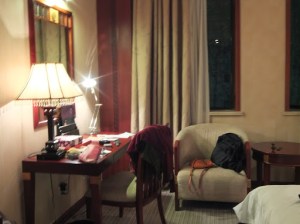
Hotel room, now with manual air con (windows)
 
The Pagoda enchanting

There are some rather nice areas in Xi’an. The South Gate plaza in front of the Big Wild Goose Pagoda was brimming with hustle and bustle in the early evening, with children frantically flying their paper kites and hordes of youngsters and OAPs alike participating in the outdoor dance class. (I for one, think the activity is a wonderful idea – you just simply walk by and start dancing, following the moves of the instructor – it’s all for free and is a great fun, physical activity and it’s also very popular in HK.)
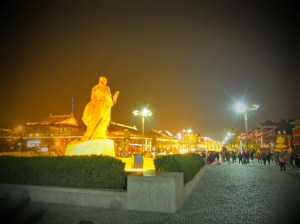
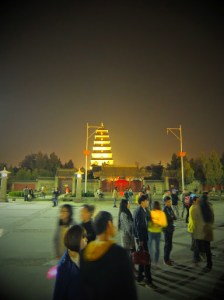


As you walk closer towards the Pagoda, you come across a charming park complete with stone set lamps, rocky pathways and Japanese gardens. Since google-maps (and generally, google) is utterly rubbish when it comes to China, it’s either the Relic Site Park, the Shaanxi Gardens or a gateway through a mysterious wormhole into another universe.
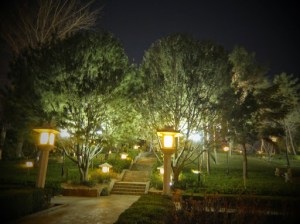
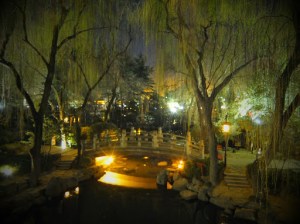
Here be some mystic shizzle


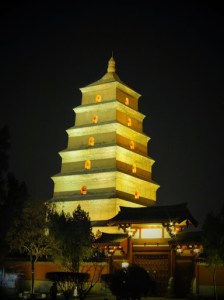
My resident Spaniard chum who was kind enough to show me around this parts, informed me that the Pagoda was full stacked high full of Buddhist books and it was a holy monk’s duty to keep them in good order. A nice story, and not one that enticed me to climb its several hundred steps to the top. So, a picturesque photo outside the Pagoda did me just fine. It is a fine looking building and with a warm ethereal glow in the nighttime, really does put the rest of the city – sprawling, semi-constructed and discordant, to shame. 
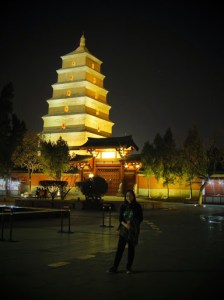
Yup there it is


Sans Katie


That said, I’m sure it’s not an altogether fair comment to make – Xi’an appears to be in a middle of a facial reconstruction. And I’m pretty sure if you had cranes and shit working on your face on the hospital bed, you wouldn’t call it your most handsome moment. It’s trying to be a new, shiny city, and before it can get there it needs to be gutted from the inside out. The problem is, the redevelopment itself is not pretty and when finished it’s not even aiming to be pretty, it’s aiming to be modernised and functional. Thankfully they’re not touching the inner sanctuary of historic Xi’an, like the Muslim Quarter, which is quite the delight.
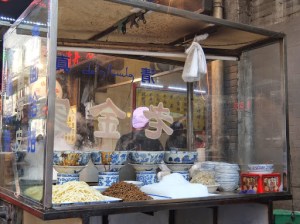
 
Typical ‘mian’ (noodle) street dishes. I didn’t dare.

The Islamic foray 
 The Muslim Quarter is crammed full of stalls and shops, which are crammed full of both delectable and perhaps not so delectable snacks and meals. Wedged in between and behind these stores were shakey little table tops and plastic tools where the residents would sit and chow down their lunch. 
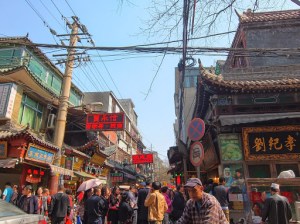
Crowds of hungrytons in a-midst the Muslim streets

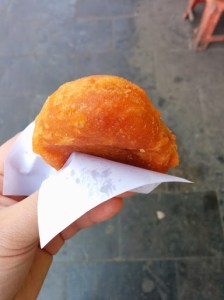
I myself, mustered up only enough courage to try this popular store, where for the hefty price of 2 yuan I could enjoy the local sweet of deep fried persimmon cake.
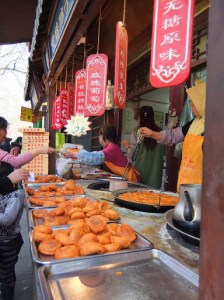
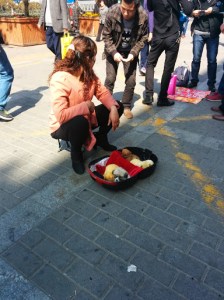
 
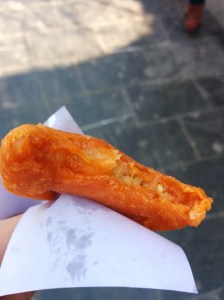
It was pretty enjoyable, although more as a holiday treat rather than something I’d grab each day for breakfast. My stomach did feel pretty growly afterwards (deep fried persimmon? wtf man), which led me to wonder how it would ever have coped had I the courage to indulge in a steaming bowl of street noodles..
 

The before shot


The post om nom nom shot
 
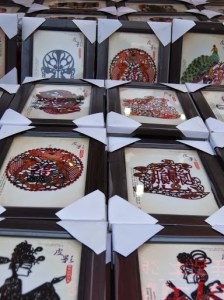
The Muslim Quarter had a great vibe about it, as well as many touristy shops selling some great tat and stuff. One thing about China that you can’t knock is that things are dirt cheap. Obviously, don’t expect top notch stuff that won’t fall apart in a few days,but you’d be hard pressed not to find something you’d wanna take home. In Xi’an, shadow puppets are a big thing, and there are a plethora of shops selling paper art which look so intricate they might tear into a thousand pieces if you touched them.
 
Just as few examples of paper art/shadow puppets on display
I was tempted to buy one of them for gifts (they started from about 15 yuan),but was persistently put off by the dodgy English on the backing paper. It wasn’t terrible like some Chinglish we’ve seen but it just served to remind me how tackilicious the whole thing was.

A little focus now on one of the above frames:
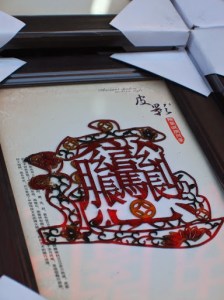
‘Biang’

Introducing you, to the most complex character in the entire Chinese language. It is made up of a whopping 57 strokes and is usually used in ‘Biang Biang Mian’, a type of thick noodle dish which originated as a humble meal for a poor farmer but became famous simply because of this famous character. It’s so complex, that modern computers have not found a way to sufficiently represent the character (some have tried – like this Biáng.svg – hard right??). So usually, they’ll make up some phonetic substitute if it’s needed. Cool huh?
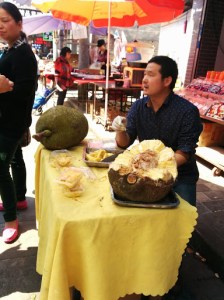
 
Speaking of other cool stuff in Xi’an.
Durian on steroids.


Shopkeeper falls asleep stroking his frog.


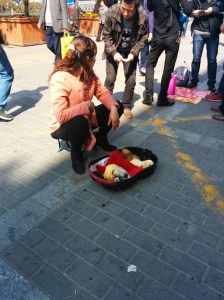
OMG LOOK AT THOSE PUPPIES. (The dogs you sick freak)


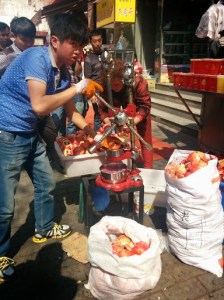
This kid pressed his pomegranate juice like his life depended on it, like serious fits and convulsions. His face was tomato red and he absolutely SCREAMED about his juice so much so it caught the attention of many amused passer-bys. I think we are all a bit scared to actually buy a glass.
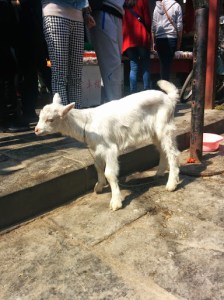
Random goat tethered to street post
See, told you it’s a goat

And then..

The ULTIMATE photobomb.

The Tower situation
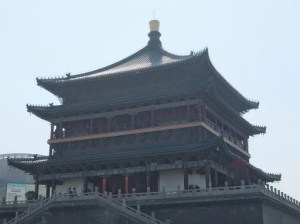
Another attraction in Xi’an was the Bell Tower, where a big effing bell inside would be dinged to signal the dawn of each day. I’m personally not one to pay good money to enter a building situated on an island roundabout, so I’ve done you guys a favour and taken a photo of the Tower, sans raging traffic around it, for your visual enjoyment. You’re welcome.


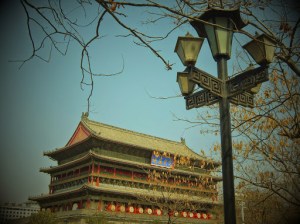
The other, slightly more aesthetically pleasing Tower is the Drum Tower, located not on a roundabout. In contrast to it’s sibling, a big effing drum inside would be donged to signal the end of each day.  I can’t emphasise how much nicer something looks when it’s not encircled by traffic. 


Now, I’ve gotten all this way without mentioning the one thing that really put Xi’an (did you know it used to be the Capital city of China?) on the map. Because, in all honesty, that’s why I came here and that’s why every tourist comes here. So yaaah, the main feature of this article is of course, the Terracotta Warriors.

But before we get there, let’s digress a little more into some other random Xi’an titbits.  

The Neolithic detour
Did you know there was once a neolithic village in Xi’an?
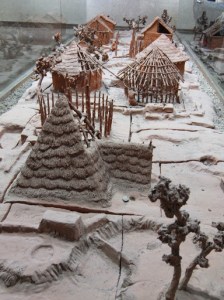

It’s called Banpo village and it looked like this. Not sure if it was quite as snowy.

I’m forced to relay this you because, although mildly interesting, it’s mainly because it was a mandatory stop on our Terracotta Warriors tour. All part of milking the tourist cash cow, people.

Of course because it’s me, it’s the morbid details that resonate. There are about a dozen skeletons at Banpo village that have been unearthed, some in shared burial sites (family, lovers, or efficiency saves), some in a pile of bones (a disturbed grave, or a shoddy burial) and others facing downwards (suggesting the deceased was actually killed for a crime committed and thus deserved no such respect). 
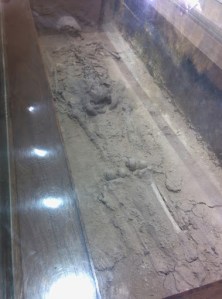
A dishonourable death


The creepiest ones for me was a small site filled with three small skeletons. They were not neolithic-man small, but neolithic toddler small. Urgh.

Another morbid detail was the use of the stone pots. These were used by the Banpo to store the bodies of their deceased babies. If you look closely, you will see a small hole at the top of the pot, which allowed the spirit of the child to ascend into heaven. The pots were often placed nearby the family homes, as there was an endearing belief that even after death, a child would need it’s mother. 
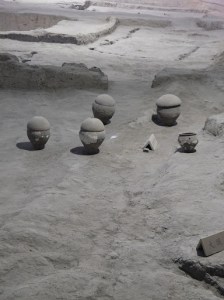
Sad stuff.

Speaking of creepy, did I mention that my hotel corridor looked like this?
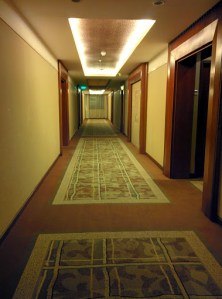
Dead looking twin girls accompanied by a tidal wave of blood, just around the corner..


If you’re familiar with The Shining, then are you thinking the same thing as me?

OK well i googled ‘The Shining corridor’ and it came up with this:
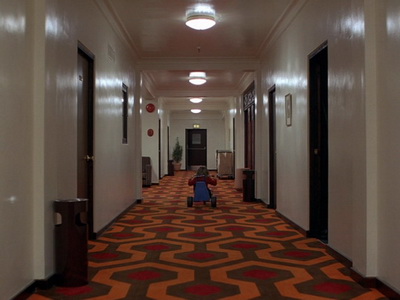


Alright, so maybe you weren’t thinking the same thing as me. Whatevs.

The Warrior Complex
And onto the main event. And I’m going to assume you’re totally ignorant about the Terracotta Army, largely because if you’re not, this doesn’t make for exciting story telling, so just humour me, yeah.

My friends, this is the Terracotta Army. 
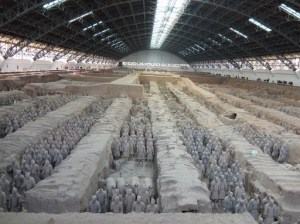
THE MAIN EVENT

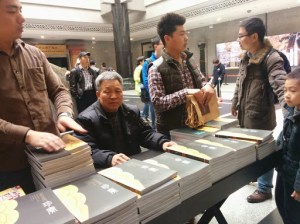
The Terracotta Army was only discovered in 1974, where a group of local farmers digging for a well chanced upon a figurine head in the ground. One of the farmers was this guy.

Hi.

He’ll sign a 200 Yuan book for you, if you pay 200 Yuan for the book. He earns about 1,000 Yuan a month to sign books and boy doesn’t he look happy about it.

Anyway, brother made the discovery and, as dictated by Chinese Law, all historic artifacts had to be immediately submitted to the government. In return, they will get a generous sum which doesn’t even amount to 1/10th the value of the artifact. Oh, and it’ll be taxed 50% too.  Fair, I think you’ll agree.

I digress.

Unknowingly, the farmers – – had just begun to unearth the largest, and most audacious  underground mausoleum ever discovered.
Qinshihuang.jpg
Qin Shi Huang Di (i.e. The ‘First’ Emperor of Qin) was arguably the most significant Emperor in China’s long history. He was tyrannical, egotistic and power-hungry. But through his bloody endeavours, he also achieved what no other leader had managed to do before him – unify the seven warring states of China. What was once a fractitious multitude of states each with their own dialects, customs, governments and even currencies – was now a unified nation, albeit through brutal and submissive wars. But Qin Shi Huang had big plans, and he delivered on them. He had a vision not only of a unified China, but a harmonious one.  He standardised weights, measures and currencies, even the national language (to Mandarin) –  he instructed the construction of a national canal and road network – and he was responsible for the construction of the country’s most iconic symbol – The Great Wall. (More on that later).  Above all else, Emperor Qin had strong delusions of grandeur – his power, rank and influence were unrivaled in his eyes (he had a point – some speculate that the name ‘China’ is derived from the word ‘Qin’), and thus even in death and the after life, his lifestyle and surroundings had to suit that of a grand emperor.
 

Soldiers on special display for repair


Emperor Qin made many enemies during his lifetime, and he feared that, even after death, those enemies catch up to him. Qin Shi Huang was a big believer in the afterlife, and that all funerary possessions buried with a man would be what he took into the next life. Not only would he have protection in the form of his army – he would have his kingdom.
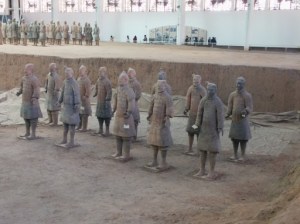
Qin apparently designed the entire mausoleum himself – his narcissistic, obsessive devotion to his own legacy taking over. Although the exact total is unknown, it is thought over  eight thousand individually modeled soldiers occupy the site in Xi’an, the majority of which are found in three pits where the soldiers are lined up in trenches. All the soldiers face east –  the presumed location of Qin’s enemies.
 
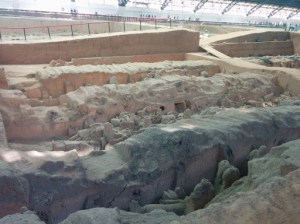
 The ‘trenches’ in which the soldiers stand guard to the East
 
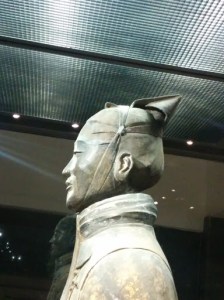
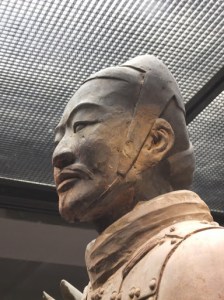
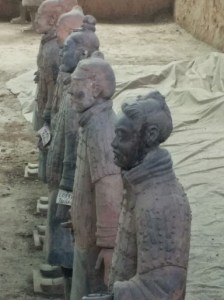
At the time of their construction, they were painted with vibrant, decorative colours and held genuine swords, spears, axes and other assorted weaponry. They are found in a variety of battle stances, and the most incredible feat achieved by the workers –  most likely enslaved by the Emperor –  is that every single warrior carries unique facial features, alongside the most intricate of life like details. (It is not unfeasible to suppose that every single member of Qin’s army had to stand and pose for modelling purposes.) 
 
As close as I’ll ever get to a warrior (through glass)
 
A General awaiting orders
 
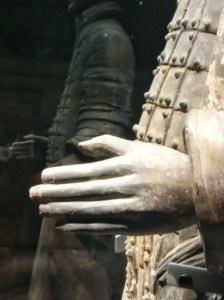
Astonishing detail, right down to the cuticle
 
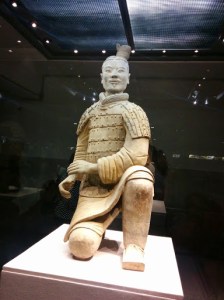
Along with the foot soldiers, there were archers crouched with their bow and arrows ready, generals (modeled significantly taller than the infantry) and horses drawing chariots.

Missing his weapon but ready for battle
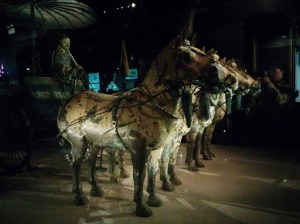
A miniature bronze chariot with horses
When the warriors were discovered, they were broken, disheveled, and heavily burned. Through oxidisation, arson, looting and neglect through time, they were a shadow of their original glory. Smudges of red or yellow paint suggested a more glorious visual. If not shattered into a dozen pieces, the bodies of the soldiers were headless –  hundreds of heads, which were separately constructed and could be fitted onto the bodies –  were strewn across the site. Many of the weapons had been stolen by the rebellion leader, Xiang Yu (which have still to be discovered) and the site had then been set on fire.
 
Headless figures in the foreground
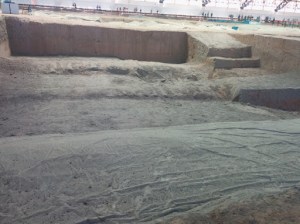
It has taken a painstaking amount of effort for archaeologists to reconstruct even a partial picture of what it must have looked like. The majority of the warriors are still to be excavated, and works are now on a permanent hiatus.  Under mounds of dirt, it is thought there are thousands of additional pieces that made up Qin’s army, but for now they just ain’t bothering to look because there are just so many.
 
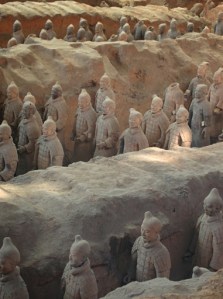
An unexcavated section of the pit where horses and chariots are assumed to lie
As mentioned, the Emperor wasn’t simply after an army – he wanted a kingdom. A reported 700,000 workers ensured that his entourage in life would carry through to after death. Among the non military figures found, were officials acrobats, strongmen, and musicians. And these were just the figures that had been discovered in the wider mausoleum grounds.
 
 
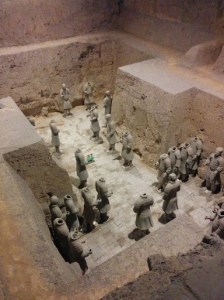
The second, smaller pit showing a group of officials
A few miles away from the site of the warriors, lies a mound at Mount Lishan. Around 76 metres under this earthern mound is the site of Qin Shi Huang’s own tomb, built over 38 years during his own lifetime, and the central point of the entire masoleum itself. Like the Terracotta Warriors, it is  a stunning accomplishment, measuring 6.3km in circumference and with an Inner/Outer city design.
 
Mount Lishan – final resting place of Qin Huang Di
 
The only documented description of the mausoleum came from the ancient historian, Sima Qian. He wrote that the Emporer had created an entire microcosm of his dynasty, complete with towers and palaces, valuable artefacts and ‘wonderful objects’. In addition, “100 rivers fashioned in mercury” were built, and above this “heavenly bodies, below which were the features of earth”. In both curiosity and suspicion, scientists have actually tested the soils within the mound and have exitedly reported high levels of mercury, suggesting that there is solid credence in Sima Qian’s claims.
Mercury rivers, booby traps, and a fearsome Emperor – all underneath my feet..
 
Amazingly, the tomb has never been excavated and will not be for several years yet.
This can be attributed to a number of reasons:

1)       The fear of the tomb being opened up the elements without adequate technology could devastate the treasures held within it. If anything, they needed a gigantic tent or canopy, of which cannot currently be produced. These were lessons learned from the discovery of the Terracotta Warriors, whose condition deteriorated rapidly after the site was opened up, so much so that only a dozen or so figures were salvaged with their original paintwork.
2)       It has been documented that the pathway to the Emporer’s tomb is ‘booby trapped’ with bows ready to fire at prospective grave robbers.
3)       Mercury is highly poisonous –  if the claims are true, then opening up the tomb could be utterly lethal to everyone and everything exposed to it. (I can’t begin to imagine what happened to the construction workers)
4)       The inefficiency and bureaucracy of the Chinese government. They don’t exactly have a fantastic track record.

There are talks ongoing that will propose a small ‘robot’ carrying a camera to be carefully placed into the tomb. This idea is at least seven years away from realisation. Why, I’m not sure but I’d refer to reason 4 above.
Whether we’ll get to see the actual opening of the tomb within our own lifetimes however, remains to be seen.  It can be concluded that the Warriors, standing guard over their Emporer for over twenty two hundred years have fulfilled their duty. Indeed, when President Clinton arrived for a tour in 1998, he stood at the front of the one of the trenches and told jokingly told them that finally, they were ‘dismissed’ from duty. And you thought you had it bad with overtime.
 
 Awaiting orders for over two thousand years
 
Only two years ago, archeologists who continue to dig around the tomb, reported finding the remains of an ‘Imperial Palace’ stretching to 170,000 square metres in size. The design of the palace can be likened to a smaller Forbidden City. Such discoveries will continue to be made and will continue to fascinate and astound us, speaking to the sheer audacity, ambition and aggression of Emporer Qin in building an eternal legacy for himself.
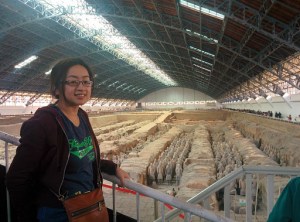
The myth of the Terracotta Warriors had always fascinated me and it was indeed my primary reason for visiting Xi’an.  When I finally stepped into the musuem itself, the experience was underwhelming, and did not inspire the feeling of awe and intimidation that I had anticipated. Looking back this should have been expected.   All the pomp, legend and beauty had been in the background story. In front of me were the sad relics of national treasures slowly devastated by the scars of time, theft and rebellion. That’s not to take away from what was still a grand sight and rightly lauded as the Eighth Wonder of the World –  but hundreds of broken, gray figures twenty foot down in a pit surrounded by a gaggle of pushy Chinese tourists was certainly not the vision that Emporer Qin had set out for. Unlike the open air musuems at Pompeii (or even Auschswitz), you couldn’t walk among the history – only zoom in on out with your camera behind steel rails, whilst elbowing another Chinese couple attempting to take a selfie with the army in the backdrop.


For those who are unfamilar with the story of the Terracotta Warriors, I would recommend you go and see them as part of a larger, China trip. My advice would be not to get caught up in the romanticism prior to your arrival –  it is a backstory best unravelled before your own eyes.  For me, I had underestimated how much of my fascination lay beneathe the lacquer and clay – it was the meaning invested into these objects, the relentless vision and ostentatiousness  demonstrated by the Emporer, and the back-breaking, excruciating efforts of his workers, many of whom died in the process and the majority of whom it is alleged were buried alive following the Maoselums’s completion, to preserve it’s secrets.
Another view of the famous Pit 1
 

Additionally, I would not personally venture on a direct trip to Xi’an if you’re travelling from outside of Asia. If solely for the reason of Visa faff, but additionally because – other than the warriors and a stroll around the Muslim Quarter, there isn’t a great deal more for tourists in China. If you’re more adventurous than me (I had an onward trip to Beijing and I’d be d@mned if I was missing that flight) then try the Biang Bian Mian on the street.  If you wanna check off all the sites on your list, cough up your cash and enter the Drum and Bell Towers. If you fancy the exercise, climb up the Big Wild Goose Pagoda. For locals, it is a comfortable city. For me, I had striken one destination off my bucket list, and had experienced a little more of ‘real’ China.
 

Leave a comment