My grandfather passed away recently, and I only wish I could have shown him more appreciation and gratitude for laying the foundations of my life, and those of my family.
Over fifty years ago, Granddad decided to make a monumental change that would affect the lives of his wife and five children. He left his family temporarily in Hong Kong and boarded a ship bound for Liverpool, and about a month later he arrived in what I know call my home country. With his brothers, they settled in Exeter in the South West, and started up a restaurant business despite barely knowing the language. He worked hard to make it a success, and eventually managed to bring across his family, including his second son, my father. The rest is (my) history.
I’ll always remember the time Granddad told us about the first couple years with the restaurant. He would get some customers who would try and walk in, eat and walk out without paying. Maybe over time, the stories got a little exaggerated and there weren’t any Kung Fu inspired, Jackie Chan-esque acrobatics. But I’d like to think there were, and I know he definitely showed them who was boss.
I’d be speaking Chinese if it weren’t for him. This is for you, 公公.
Man Uk Pin (萬屋邊), as the bastardised English name has it, means “Ten thousand houses on the border”. Sure, ten thousand is a bit of an exaggeration, but we Chinese like to add a bit of drama into the mix. I haven’t quite gotten to the bottom of what the ten thousand houses refer to – it most likely refers to the village homes, but I secretly wonder if it alludes to the graves that visibly dot the hillside, on the approach to the village.
.JPG) |
| Village in the top left – where I currently live, is by the ‘d’ in Aberdeen..! |
The border I presume refers to the location. On the map, it is at the uppermost point of Hong Kong, bordering the Mainland Chinese province of Shenzhen. Wholesale home of all those Forever 21 accessories, as well as a popular meeting point for dubious businessmen looking for some after-hours fun.

This small village, a mini bus ride away from the town of Sheung Shui (上水 or ‘Up Water) is where my father and his four siblings were born and spent their childhoods. It is entirely surrounded by greenery, and further along the horizon, the mountains which split Hong Kong and China. Water runs down from these mountains into streams and man-made waterways that wind through the village.
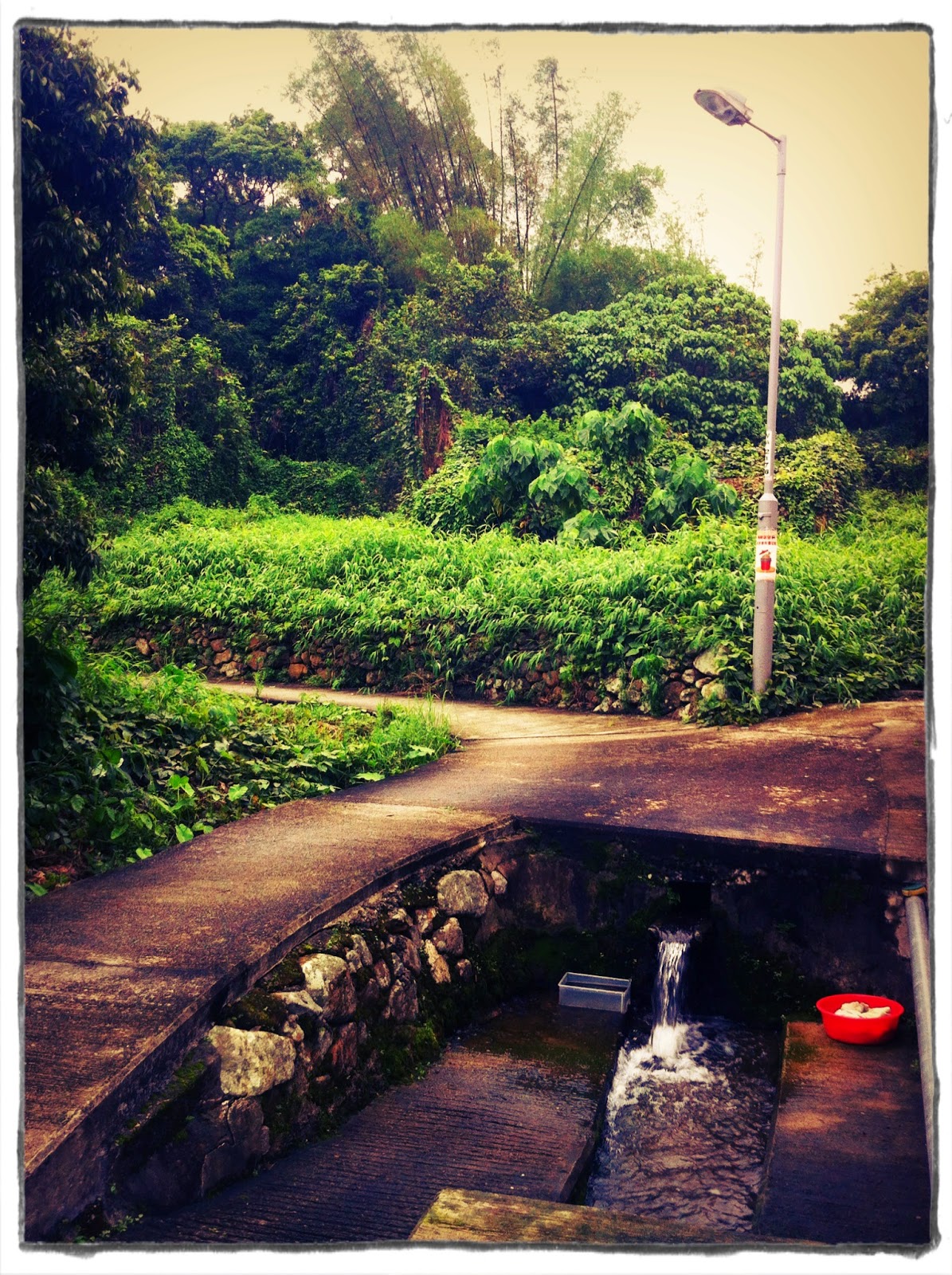 |
| I remember several occasions where Mum asked me to take a bucket and bring back some water. I found it so novel, it was always done obligingly. |
Due to it’s proximity to the Chinese border, there has historically been issues whereby migrants illegally cross over to Hong Kong in the dead of night. On one occasion when I returned with my family, I was shocked to see acres of grassland had been burnt to the ground. I was told that this was on authority of the government who did not want illegal migrants hiding in these tall bushes and therefore ordered it so. Lately it doesn’t seem like they care too much, so I’m hoping it was a one-time impulse thing.
The village began with four households with four different surnames, once of which was my own. Today, there are still four small shrines in Man Uk Pin, with the respective surname painted above the entrance.
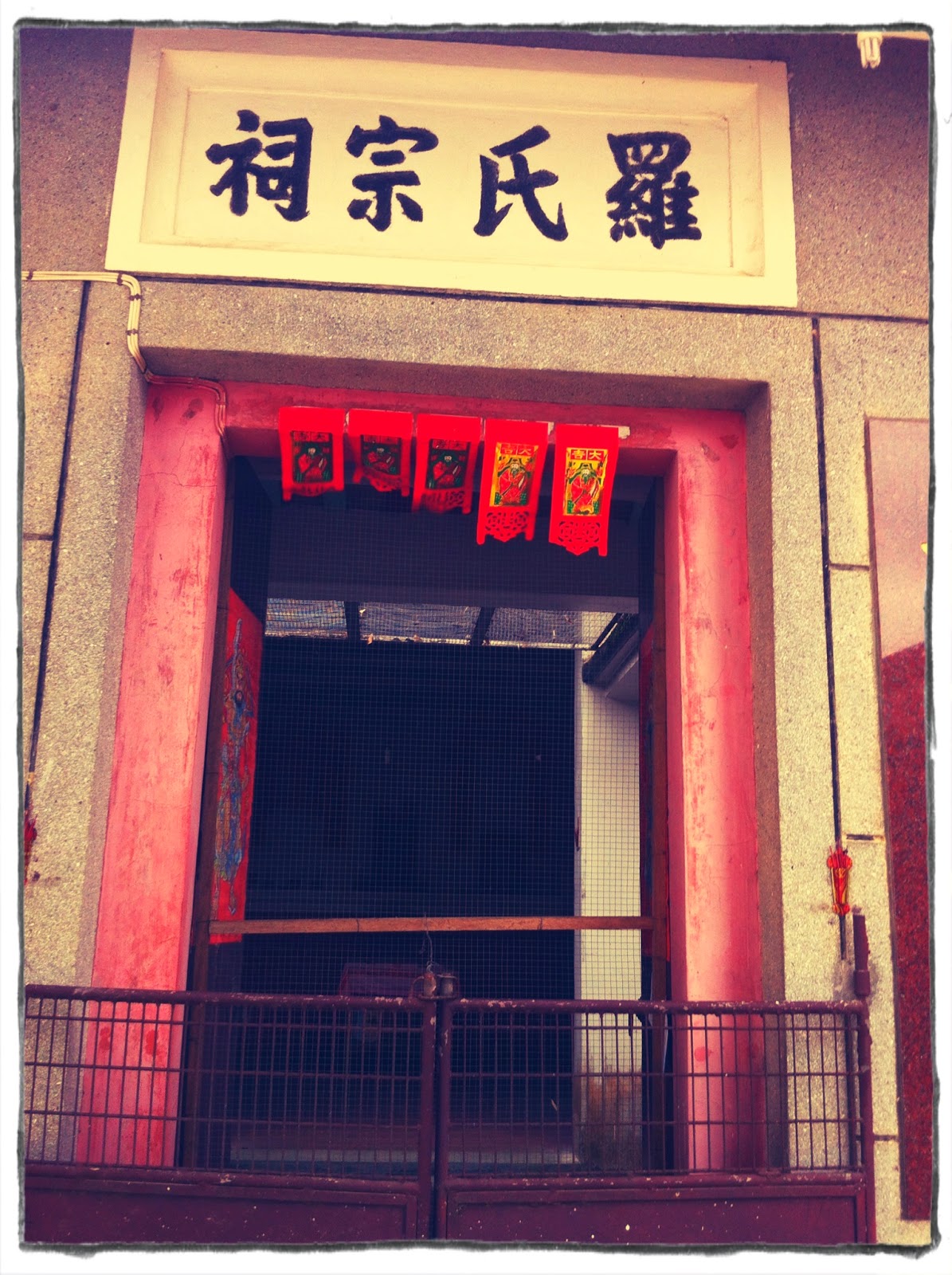 |
| The entrance to the ‘Law’ family shrine. The last character is ‘Law’. You can just make out the small alter upon which food and wine is placed, in offering to both the Gods and the ancestors. |
In recent times, Man Uk Pin (萬屋邊) has gradually gotten more and more caught between two worlds. On one hand, it remains largely desolate and run-down, with grannies living stubbornly in their childhood homes built within stained walls sheltered by rusted tiles. Around each corner, there will be an abandoned house with chains and padlocks at the door and weeds sprouting from every crevice. On the other hand, Man Uk Pin has been both regentrified as well as redeveloped. There are many families like mine, who, despite going overseas for better lives, retain the ancestral land and return to rebuild an appropriate home for their retirement, their holidays, or their extended family. The appropriate chinese aphorism is that ‘Falling Leaves Return To Their Roots’, a saying which has been popularised by Adeline Yen-Mah’s biographical book. As well as returning familes, there has been an inevitable creep of foreign development.
This year, my dad told me that the first Westerner had moved into Man Uk Pin – upon pondering, it isn’t much of a surprise. It is a quiet, picturesque location with clear enough skies to see the stars at night. I assume it’s within driving distance to whatever business he had within the northern end of the New Territories, and given the quite frankly frightful property prices of a flat akin to a broom cupboard in other areas of HK, not a bad investment at all. There is a large piece of communal land in the village which is presently, and for decades – has been unoccupied by nothing but shrubbery, grass and probably a few snakes. The village elders have recently given their permission for this area to be redeveloped into new housing – whilst the construction will be a plain eyesore for all the villagers, and the new residents a foreign and unfamiliar sight, it will nonetheless be money that will be reinvested back into the tiny community.
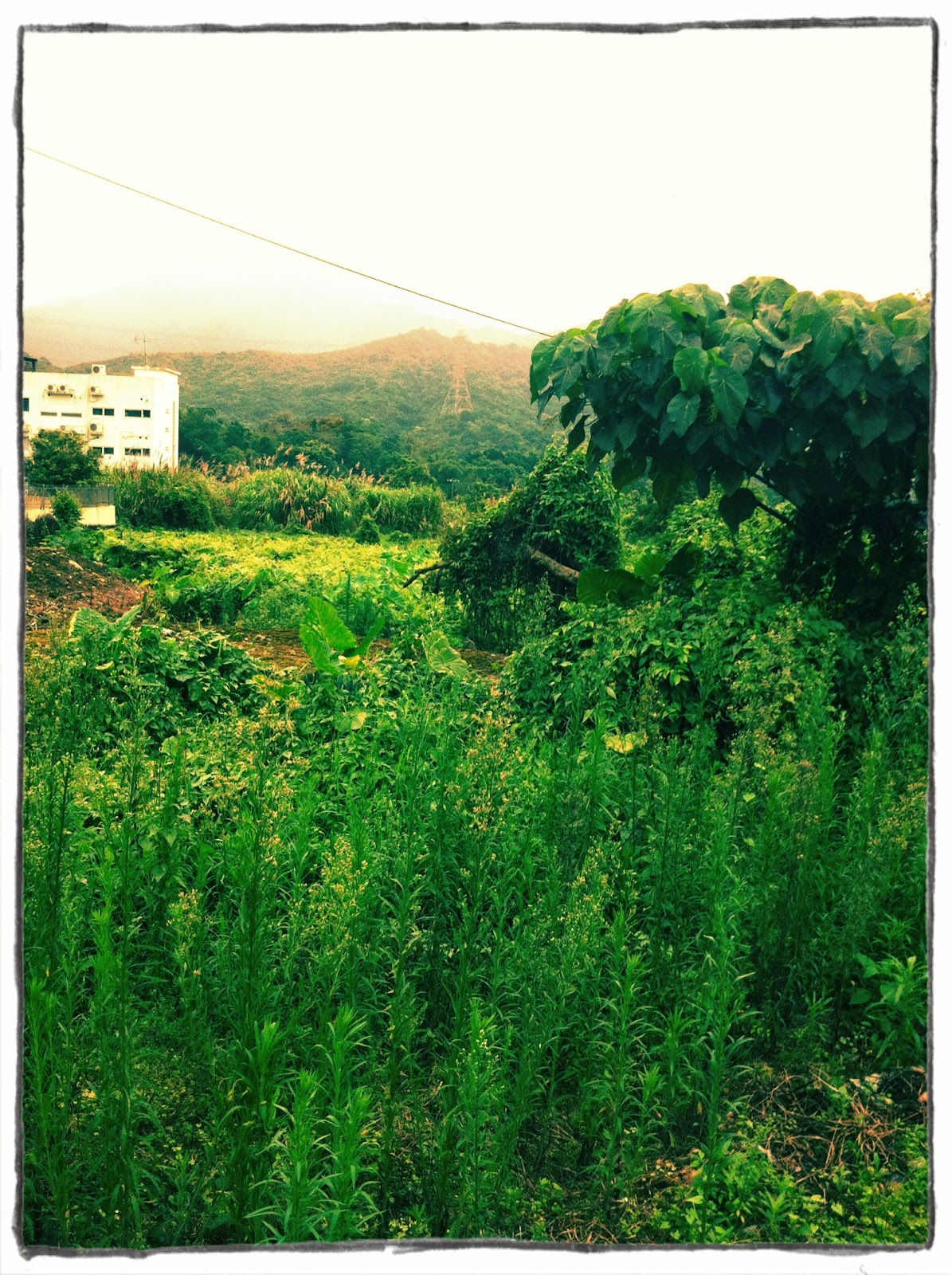 |
| Lush green land which surrounds the village, but will soon be transformed into new housing |
There are dozens and dozens of such villages along Sha Tau Kok road, and the acres of land that span these villages will represent many hidden gem investment opportunities in the coming years.
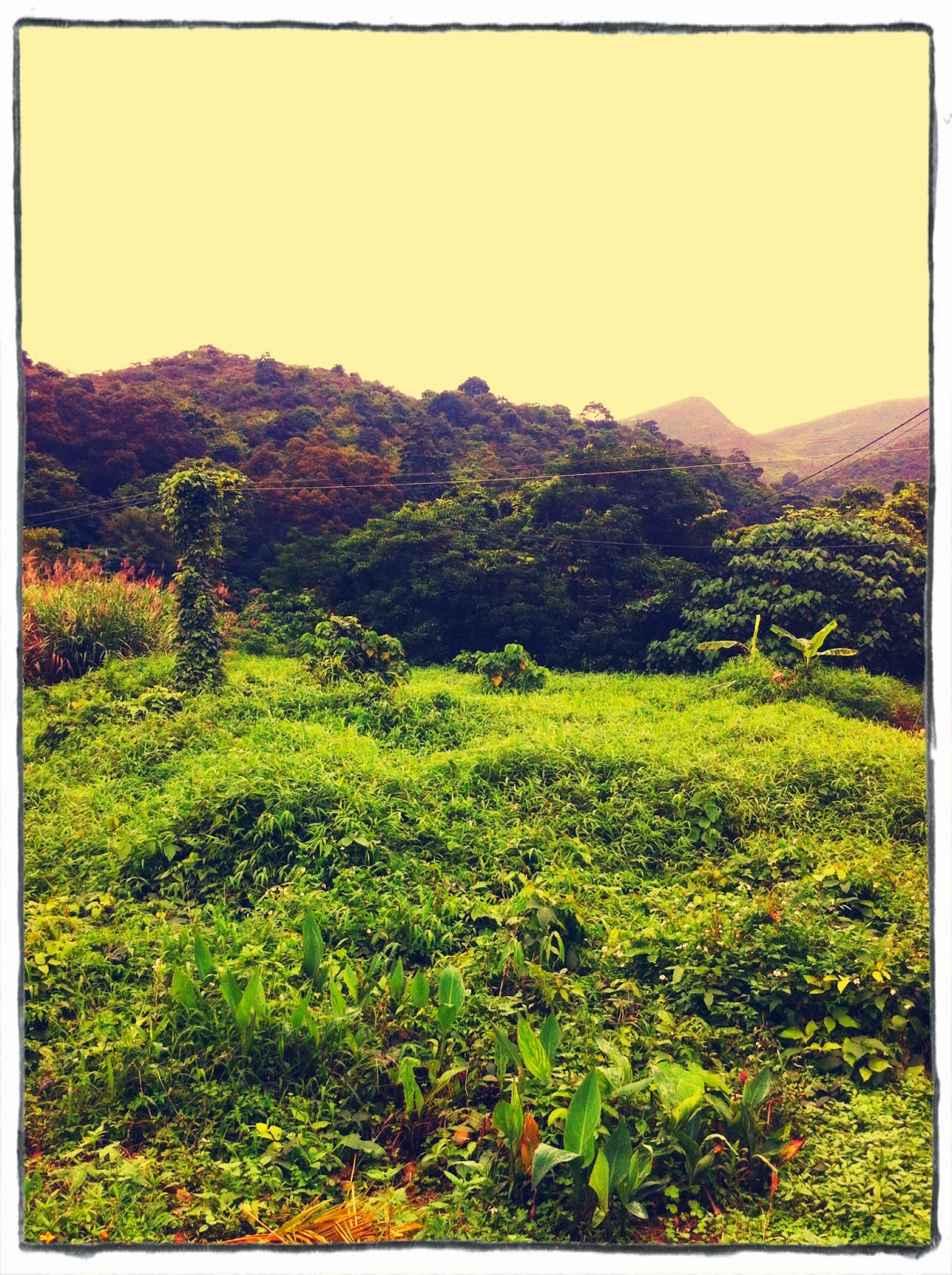 |
| Precious real estate for an increasingly popular location |
My dad was the second eldest of five kids. The whole family were born, raised and schooled in Man Uk Pin. The plot of land where our current house resides was not where he originally lived. His old house is now a white washed parking space. I remember going back years ago before they had cleared the area, and all I saw was a small rectangular space overrun with weeds, surrounded by the foundations of four brick walls. I could barely imagine how they managed to squeeze seven people into that small space.
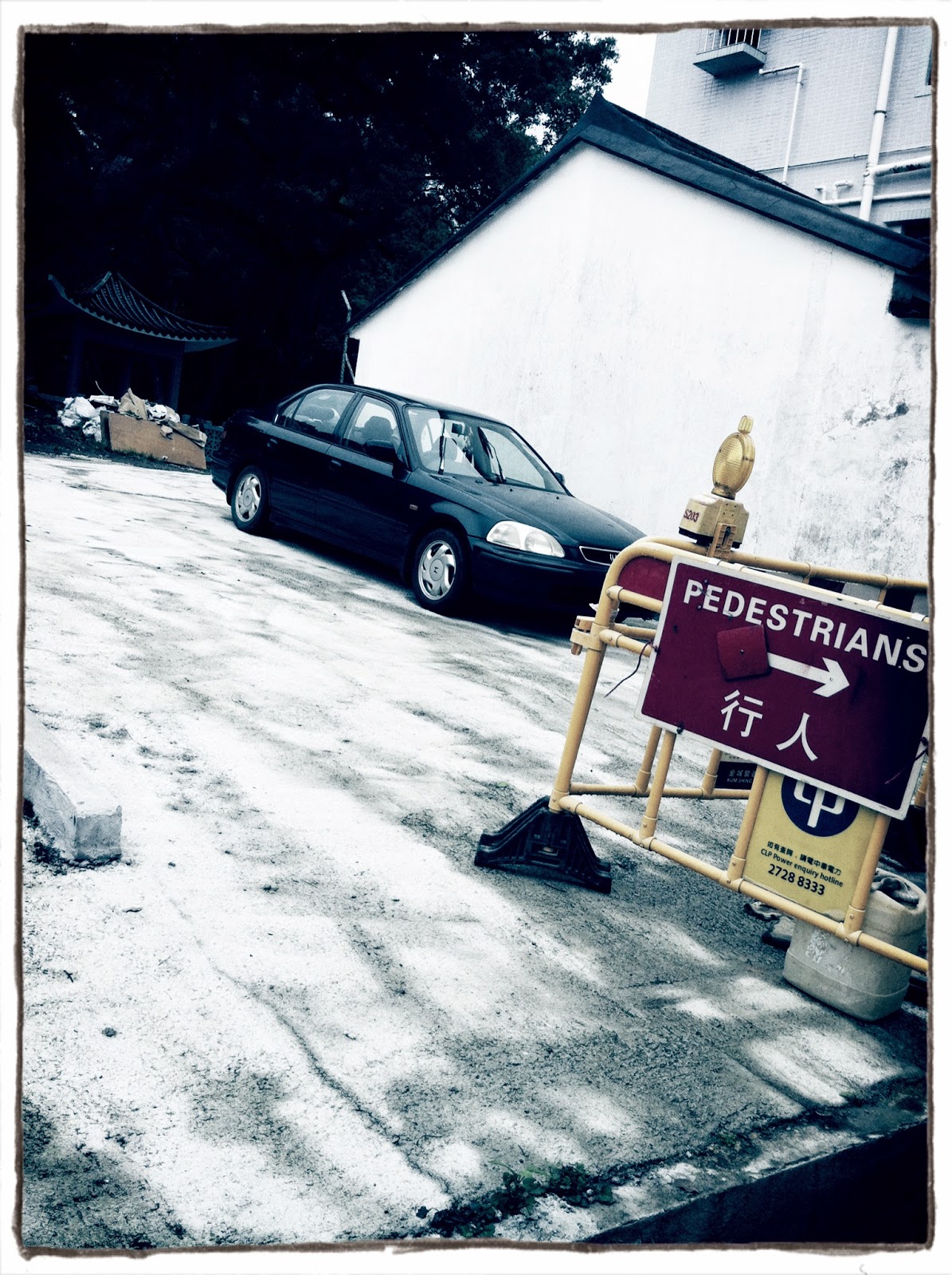 |
| The length of the old house is clear to see. The width ran from the edge of the visible building, to perhaps the right side of the parked car. |
There are a couple of sad sights in the village. One is the area which used to be my dad’s primary school. The land is so densely packed with overgrown branches, weeds and dilapidated structures that it is now closed off for safety’s sake.
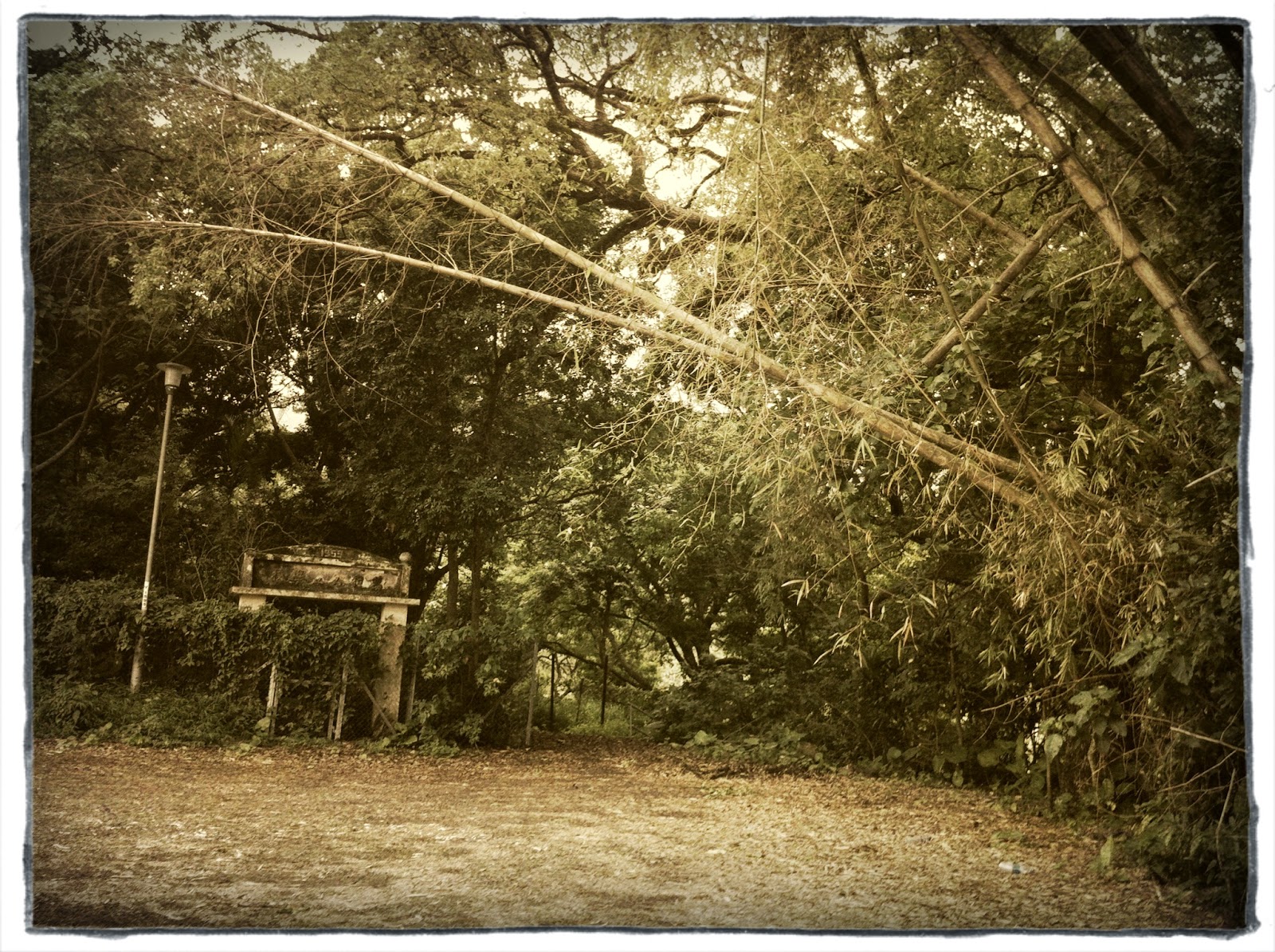 |
| My dad told me that the kids would play football in this open yard, in front of the school. |
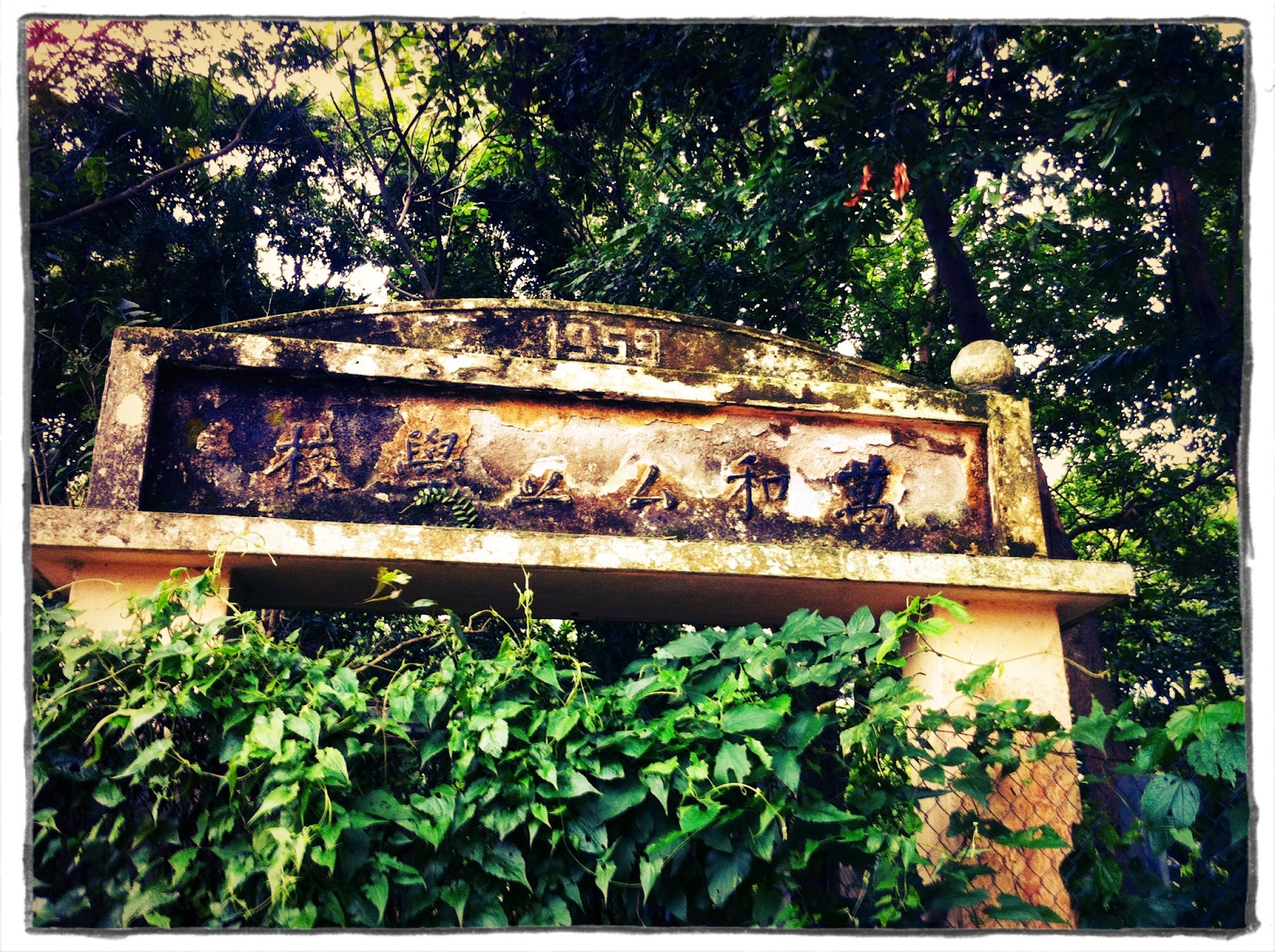 |
| The entrance to the school with it’s opening date 1959. |
Next to the abandoned school, there is now a small farm where primary school kids in the New Territories come on day trips to plant vegetables in their own little allotments, attaching small tags to the earth bearing their names. To my delight, there are also rabbits and guinea pigs housed here.
 |
| My auntie has also grown some tasty papayas! |
A fun fact I was told was that there has been at least one production crew group filming around Man Uk Pin. In some areas, underneath old sprawling trees and tall grasslands, you can imagine it looked exactly the same one hundred years ago, so it does make for an ideal TV studio if you needed some lush greenery as backdrop to a historical Chinese drama.
As previously mentioned, a lot of the village is run-down, with some buildings reduced to mounds of rubble. Some abandoned houses still stand but with gaping holes in them, and a family of stray cats wander around foraging and surviving on the leftovers of dinner put out by the villagers. The majority of houses are very small and densely packed, running through the spine of the village. They’re almost like terraced houses. One can imagine it is very difficult and also not very worthwhile to fully demolish, clear and redevelop in these spaces. So they are just left as piles of dirt and rubbish, permanent skips. Other properties which are moreso on the outskirts are larger and grander. Unfortunately a few of these are also uninhabited and nature has pretty much had it’s way with them.
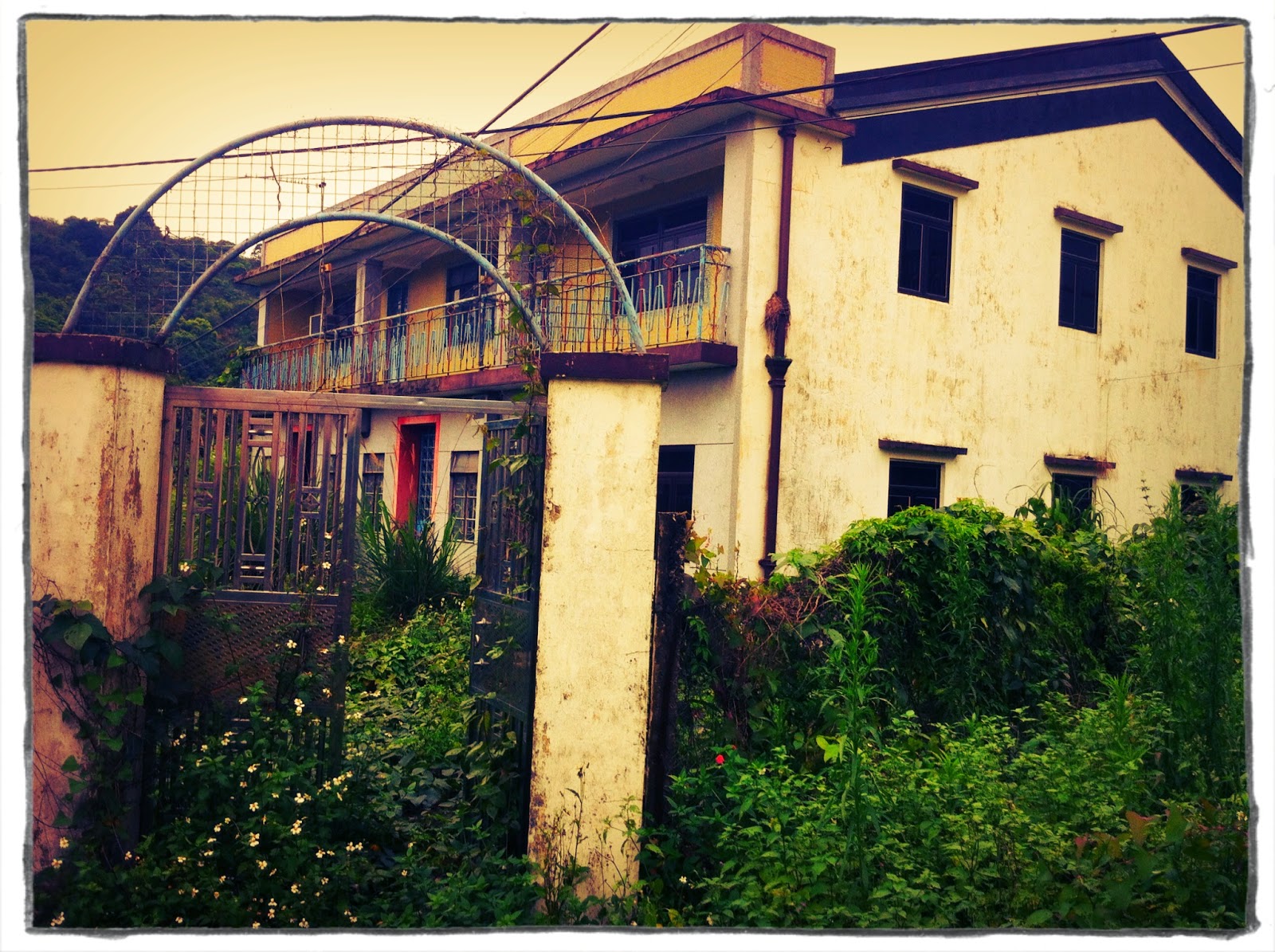 |
| An empty property which hasn’t been looked after in years – the entrance is permanently open and it probably won’t shut anyway without some serious gardening being done. |
My parents own place is well maintained, pretty much because my auntie lives there now. We have only typically returned once a year, staying around two or three weeks at a time. When they pass by a villager, there is always a friendly greeting and a casual comment like ‘Come back, have you?’, which may then leads to a conversation about how healthy the plants in their garden look, whether their great Aunt is keeping well, or maybe who else has come back to the village recently from abroad for a holiday.
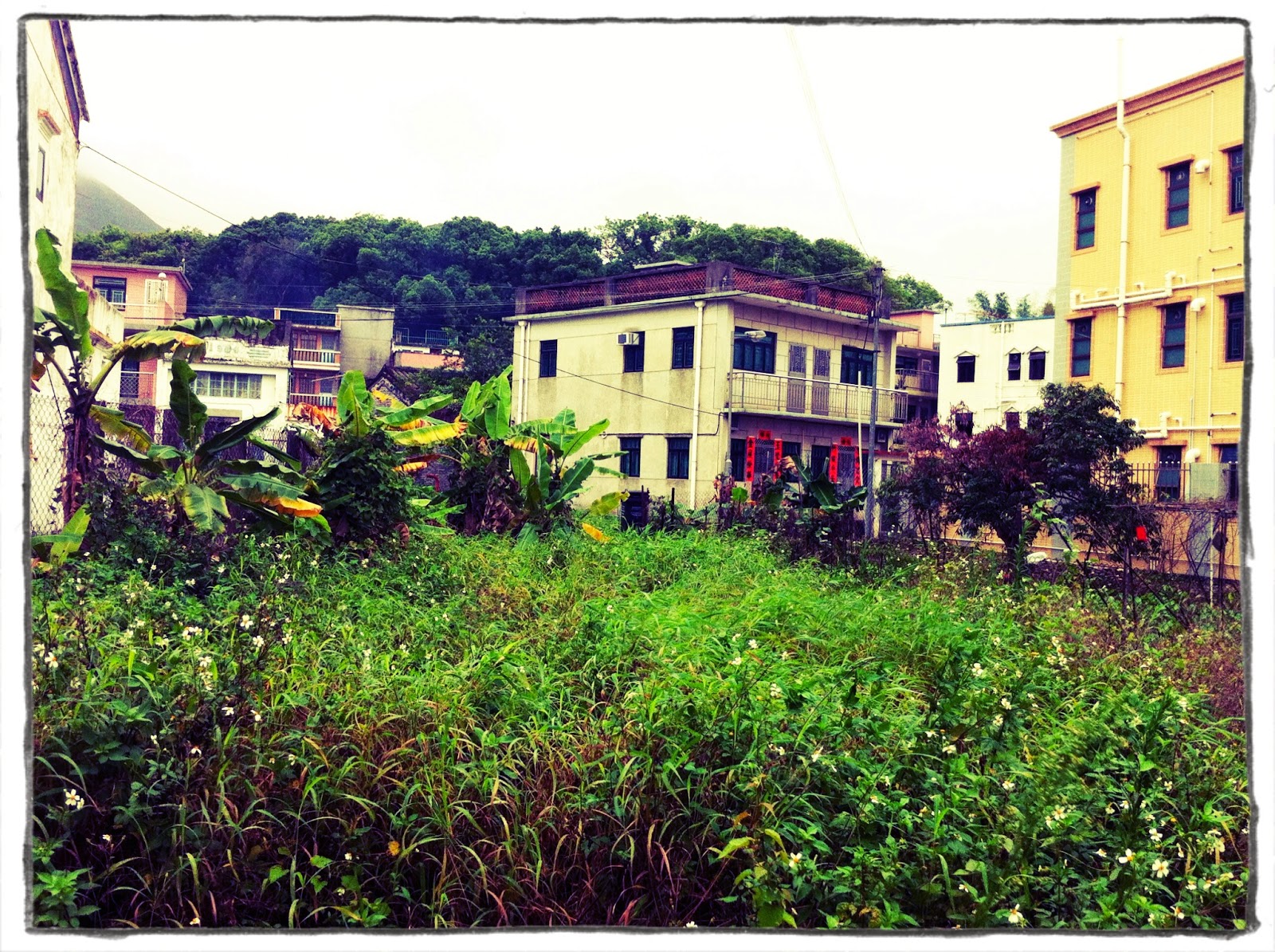 |
| A typical view inside Man Uk Pin |
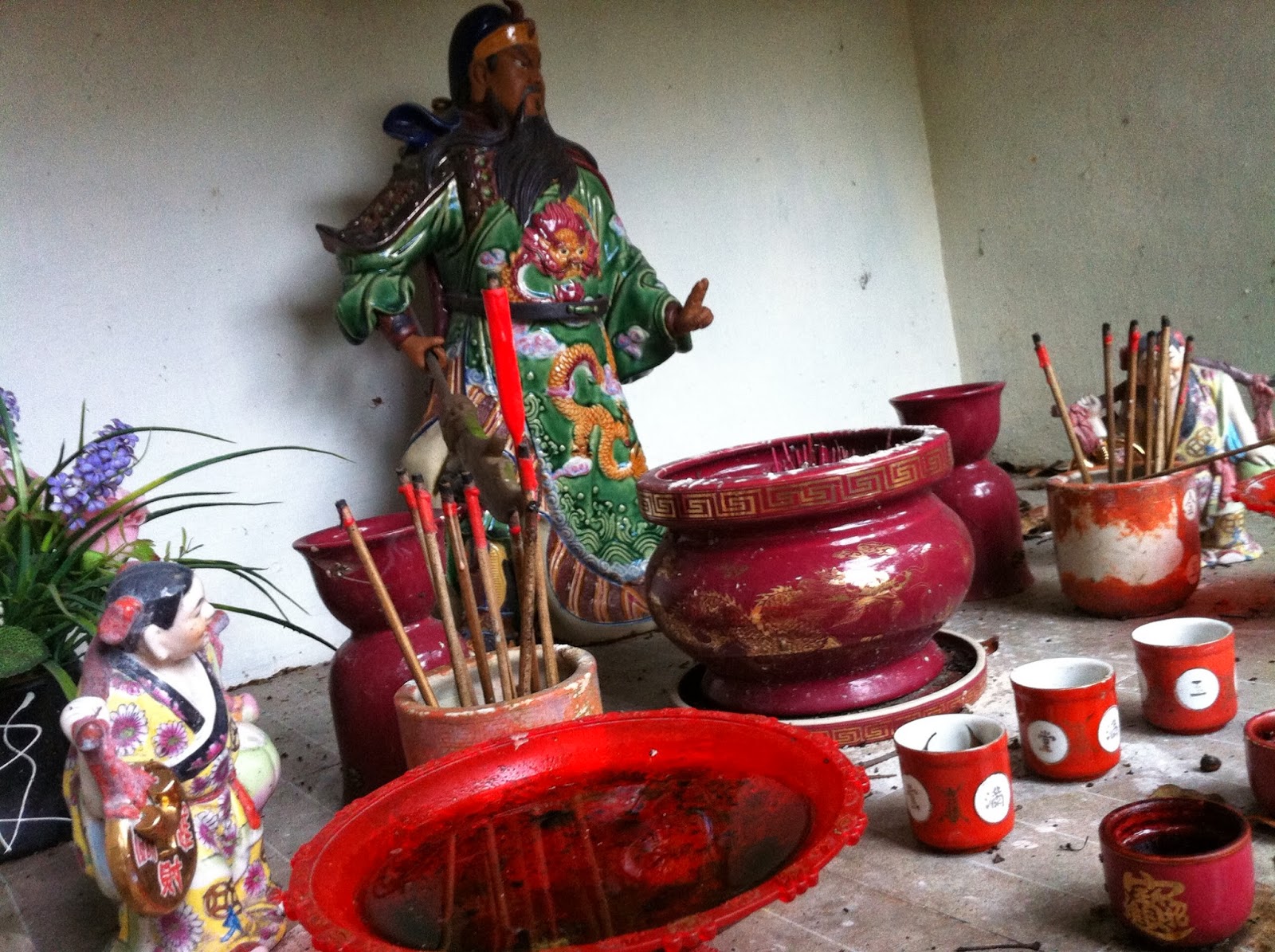 |
| The contents of a small stone shrine/alcove alongside a walking path. Incense, wine, and a statute of (what I know now to be) the God of War, Guan Yu. He is said to subdue demons. |
Now, the further out you venture from the houses, the dense and green it gets. You can get as far as hiking up the mountains to Shenzhen, which a group of us did once. I got a kick out of getting a China Telecom signal at the top – like I was roaming in a different country. I also still have a photo (developed, like in the olden days, so I can’t blog it) of my younger brother ‘climbing’ over the barbed wire fences, to, er, freedom – to China.
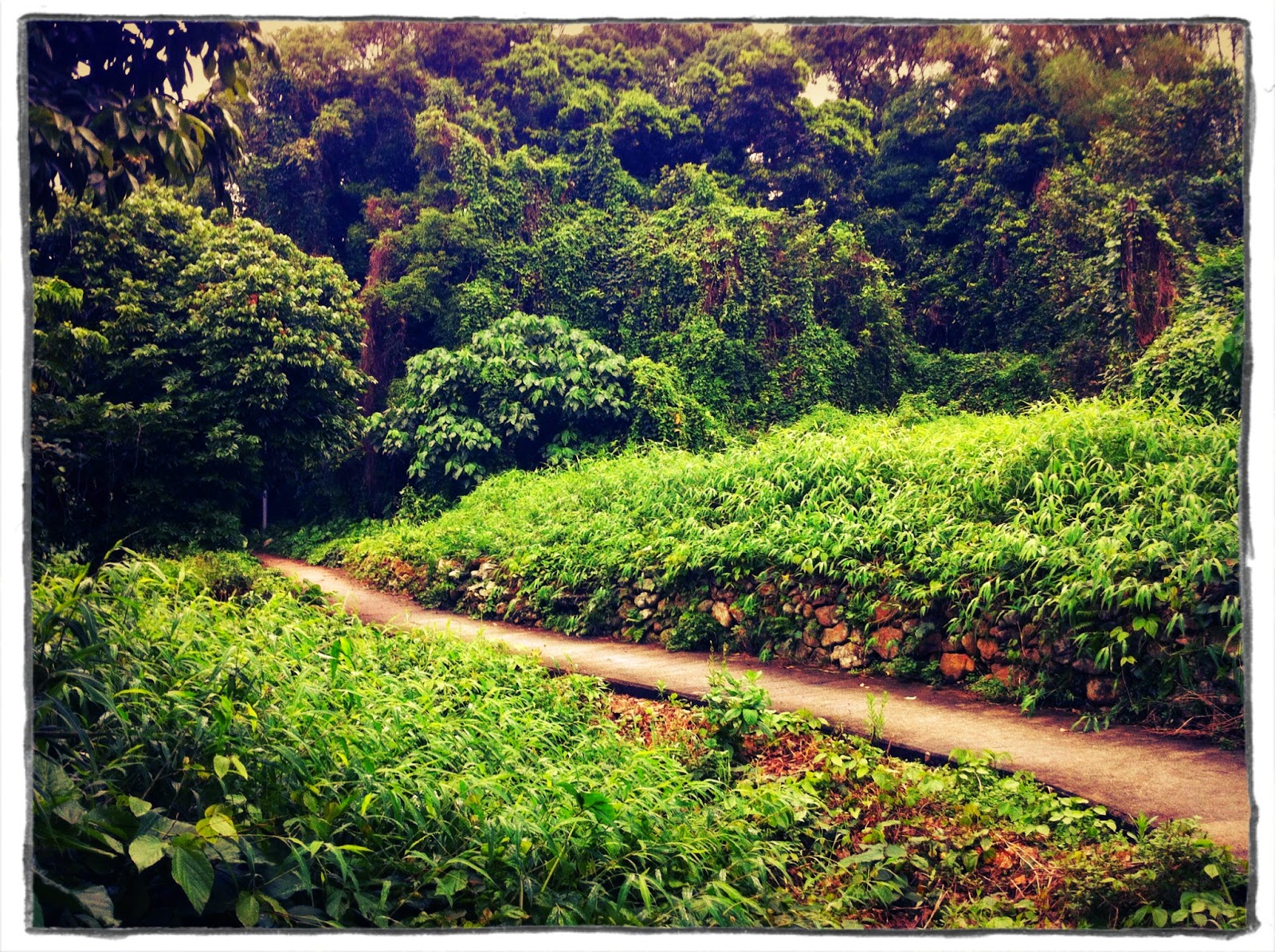 |
| Paths that lead to streams and Star Fruit trees |
There were a couple of stories that my uncle told me, that for the life of me I wish I could properly remember. I recall he spoke about their dozen guinea pigs, descriptions of the streams which he and my dad used to splash about and play in, and the evil hounds from one of the neighbouring houses which would chase after you if you were within a hundred yards of it’s property. Actually, that last one was probably a recent thing, as I do recall running for my life on one occasion when a few of us strayed too far from the beaten path. What I do clearly recall, was the nostalgic expression on his face as he looked over the trees and mountains, following the end of our ascent to the borders of China. I could imagine that all his childhood memories were passing through his head fondly at that point, and how much had changed since that time.
So finally, my house, or rather my dad’s house (which will then become my brother’s, because girls can’t inherit property, pfft).
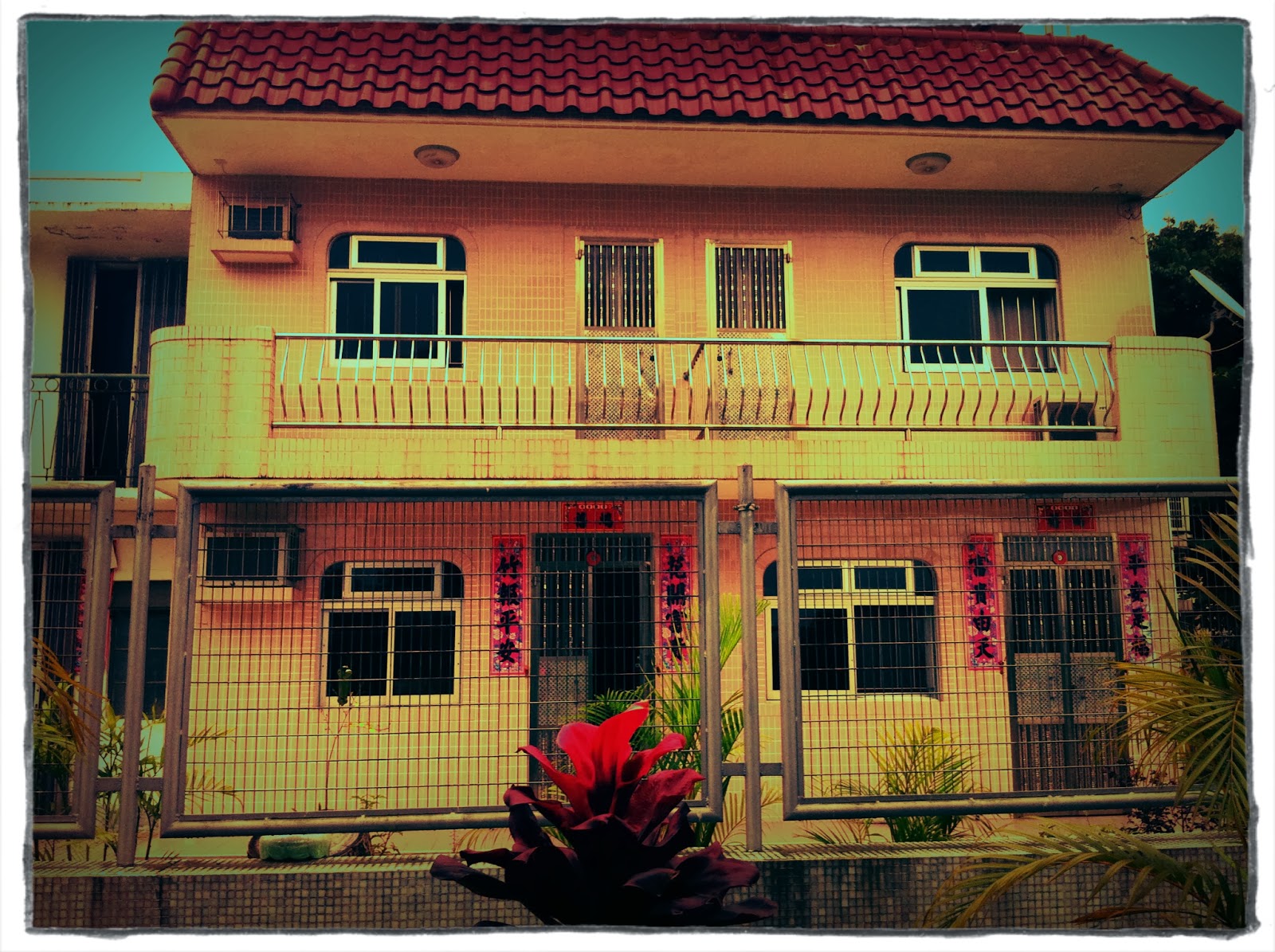 |
| The Law abode |
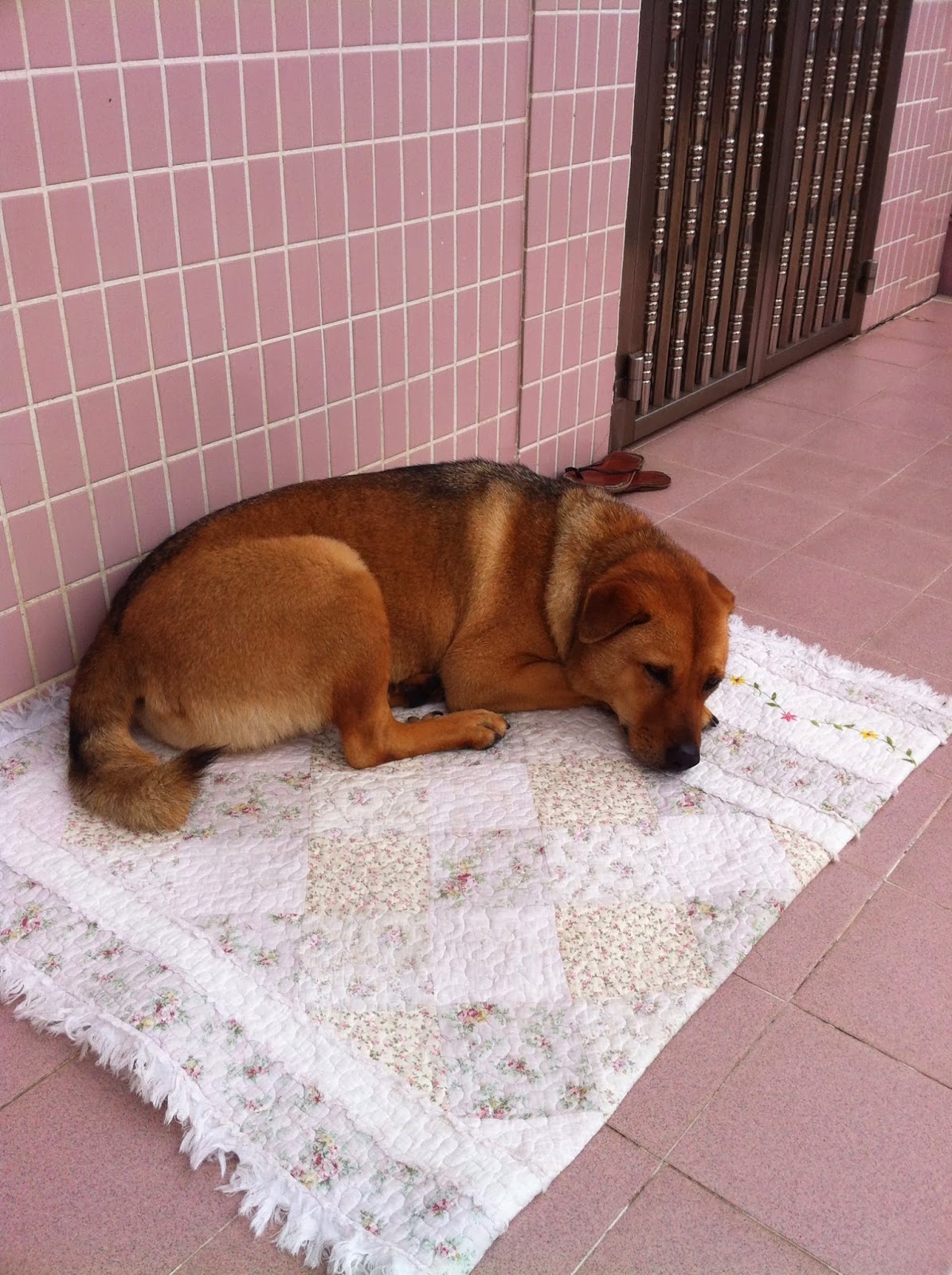 |
| Lily chills on guard duty
My auntie has had Lily since she was a pup, after she retired and returned to HK. She’ll typically sleep outside the house, within the gates, because she thinks it is her duty to watch guard over her faithful owner. Whenever she hears someone approaching the house, she barks the place down and growls threateningly at said intruder. However, if my auntie casually asks her to quieten down and goes outside to greet the intruder, Lily will promptly shut up and never bother them again. She’s lovingly loyal, and also knows how to shake your hand. I enjoy looking out over the village either from the terrace or from the roof. I work on the 53rd floor of the fith tallest building in Hong Kong – you can see for miles, and for miles you see a chaotic mass of harsh grubby steel and concrete, and air conditioning units. Here, you don’t see such things, and I swear it’s fruit and veg for the eyes when you look out over a landscape that is so much more gentle to consume. |
 |
| The view from my terrace, overlooking the patio. Great for a BBQ if ever we have one. |
 |
| Vibrant colours around my patio |
That is my bestest description of my home village, where 10,000 houses haunt the hills. It’s not totally accurate, and there are perhap a dozen better stories and facts to tell you. But it’s what I know, and I wanted to write it down so that I don’t forget, or at least forget to appreciate where I’ve come from.
Unfortunately I couldn’t make it to my Granddad’s funeral. I know however that my cousin, who was very close to him, said a few words, including repeating those he had spoken about his children and grandchildren. He said that he was very proud of us all, making successes of ourselves in the world. He also said that, we should not forget to enjoy life and not work ourselves to the ground. I wish I had shown my gratitude to him more when he was alive. Instead, all I can do to make him proud now, is to try and heed his words as much as possible in my own life. I hope I never forget what he has given me.
 KJK
KJK 